



© Hargraves
Western seaweed processors are approaching a structural constraint. Demand for macroalgae-based inputs is accelerating across animal and pet feed, biostimulants, nutraceuticals and biomaterials. Processing innovation is advancing and regulatory frameworks are maturing. The World Bank predicts that these emerging applications will reach a global market size of US $11.8 billion by 2030.
But biomass availability – not chemistry, regulation, nor processing technology – is becoming the limiting variable.
At current volumes, temperate seaweed systems perform well. Wild harvest and limited cultivation of species such as Ascophyllum nodosum and Saccharina latissima remain commercially viable within established, high-value niches. However, we can expect constraints to appear as soon as volumes begin to move beyond those niches.
If seaweed inclusion shifts from supplementation to a meaningful inclusion rate in feed or agricultural inputs, Europe and North America are unlikely to be able to scale effectively on domestic temperate biomass alone.
The biomass constraint
Temperate seaweed supply faces three structural limits:
- Ecological ceilings: wild harvest volumes are bounded by regeneration cycles and increasingly stringent environmental oversight. Expansion is slow and politically sensitive.
- Cost structure: labour, compliance and coastal infrastructure costs in Europe and North America are among the highest globally. These are workable in specialised extract markets, but increasingly prohibitive in bulk inclusion sectors.
- Seasonality: temperate growth cycles do not deliver continuous, high-throughput biomass flows optimal for industrial-scale adoption.
At modest demand levels, these constraints are manageable, but at mass inclusion they become challenging, particularly in agri and aquafeed.
Seaweed is no longer being evaluated purely as a niche additive. Trials with various species, including Southeast Asian species, consistently report improvements in feed conversion ratio, gut health, immune response and partial fishmeal substitution. Technical teams can formulate for 2 to 5 percent inclusion in performance-driven aquafeed, yet procurement teams understand that local temperate biomass cannot sustain that shift.
At a 2 percent inclusion rate across 5 million tonnes of European aquafeed, current wild harvest capacity would be effectively absorbed. At just 0.5 percent inclusion across 150 million tonnes of combined European animal feed, approximately 6 million tonnes of wet red seaweed would be required – roughly half of Southeast Asia’s current output, yet only a fraction of its expansion potential.
In this context, the biological ceiling of domestic temperate biomass becomes clear: it constrains formulation ambition. Research and development momentum is advancing, but commercial expansion remains bounded by raw material availability.
The tropical cultivation reality
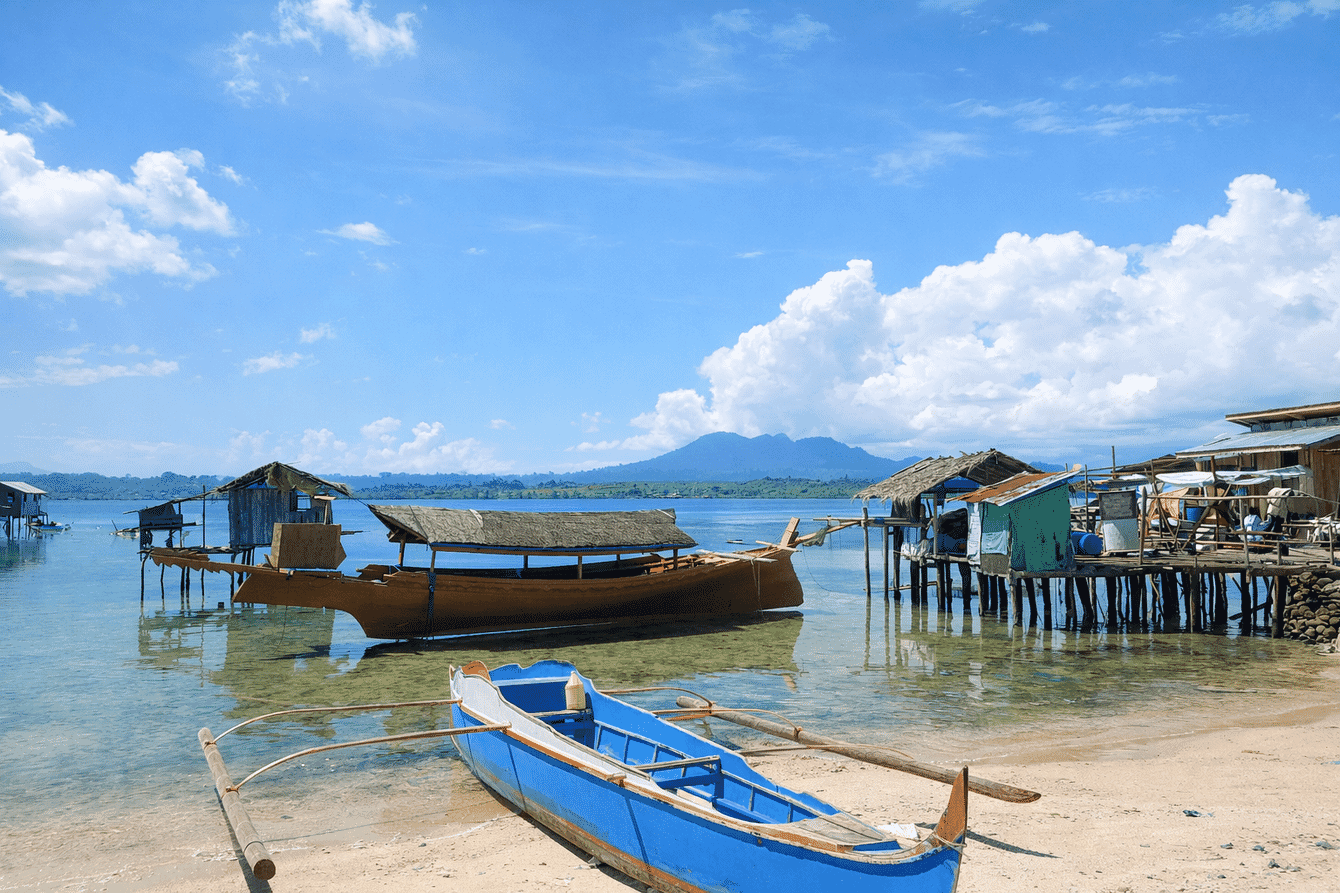
Cultivated tropical red seaweed – particularly Kappaphycus alvarezii (previously known as Eucheuma cottonii) – already operates at mass scale across Southeast Asia.

© Hargraves
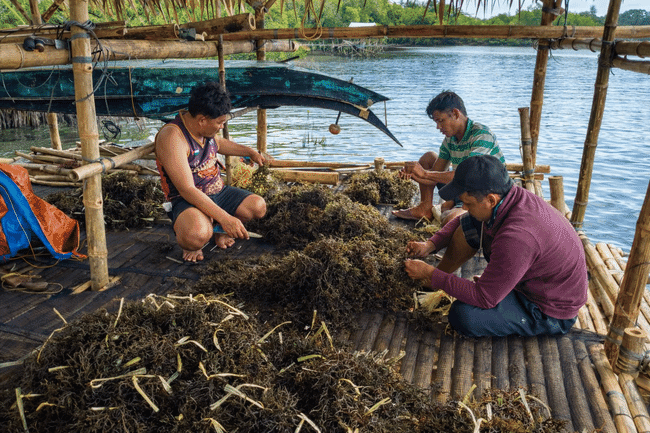
The Philippines and Indonesia collectively produce a third of global production: over 11 million wet tonnes annually through distributed smallholder networks, four-to-six-week growth cycles and year-round harvesting.
It is worth noting that this has been achieved despite fragmented smallholder systems, poor infrastructure, exploitive financing and logistic inefficiencies. These are industrial issues that can be addressed through better infrastructure, more effective financing and more organised supply-chains, enabling uses that are already biologically possible but not yet realised at scale.
Production is also structurally expandable by an order of magnitude by hectarage alone, not accounting for productivity improvements from genetic and field improvements. Less than 10 percent of identified appropriate area is currently utilised. Uncontested space, continuous warm-water growth, intergenerational farming knowledge and geographically dispersed island production create significantly greater throughput elasticity than temperate systems.
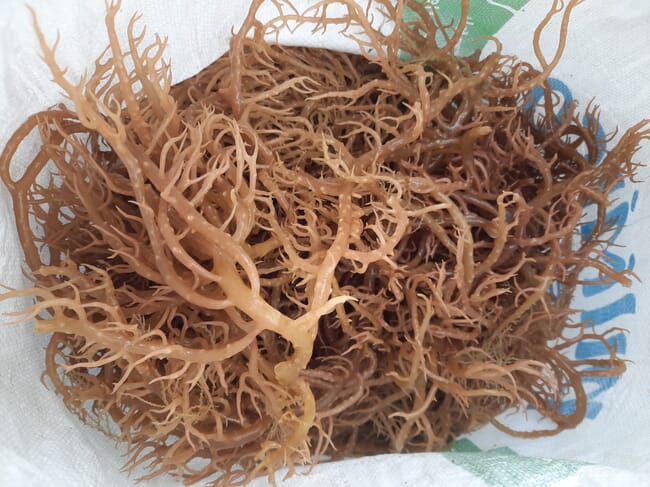
Today, this biomass is channelled mainly into carrageenan, but it can also be processed into suitable ingredient forms for most emerging markets, including feed and biostimulants.
© Hargraves
Substitution, differentiation and functional fit
Tropical red seaweeds are not chemically identical to temperate brown species, each has its own bioactive profile. Some perform better in specific applications, others are more affordable, and others are more scalable. A few perform well across all metrics.
In bulk markets, the question is not bioactive symmetry or superiority, but functional performance at scale – delivering effective outcomes for end users while being able to scale to meet a market boom.
© Hargraves
In feed and biostimulants, buyers prioritise measurable outcomes: growth response, gut modulation, stress tolerance, microbial interaction, binder performance and cost per tonne. If multiple species can deliver comparable outcomes within defined specifications, supply reliability and inclusion feasibility become strategic factors.
At niche volumes, higher-cost inputs remain viable – but at mass volumes, biomass elasticity determines viability.
Historical familiarity with local species does not automatically equate to structural optimality in high-volume futures. As global supply chains mature and species–application matching becomes more data-driven, cultivated tropical reds can serve as economically rational inputs in many markets where performance outcomes align.
Cost, structure and the compliance gap
Cost dynamics follow structural asymmetry. Tropical cultivation benefits from continuous and quick growth cycles, household-embedded labour systems, distributed micro-farming networks, lower infrastructure costs and generational cultivation expertise. As regulatory oversight intensifies and wild harvest ceilings tighten in temperate regions, relative cost divergence increases.
In high-margin extract markets, this may be marginal, but in feed markets; it is not. When inclusion rates rise, raw material consumption rises non-linearly and small cost differentials compound rapidly.
© Hargraves
There is a justified caution towards tropical supply, as traceability gaps, inconsistent quality and documentation weaknesses remain barriers to direct integration. However, these are compliance constraints, not biological ones.
In regions where certification alignment, batch-level documentation and embedded quality control systems are established, integration barriers fall and economic comparisons become more transparent. The decisive question is not whether tropical supply meets Western standards today, but how quickly it can get there. Current trends suggest that efforts on this front will result in significantly improved international market accessibility across South-East Asia by 2030.
Seaweed supply in a changing climate
Temperate systems operate within relatively narrow ecological bands, and warming waters combined with an intensified oversight could further constrain wild harvest expansion. Tropical systems also face their own risks – including heat stress, epiphytes, disease and typhoon exposure – but benefit from year-round growth cycles and geographic dispersion. The key difference is not stability versus instability, but regeneration speed and spatial flexibility. When global biomass demand increases, systems with shorter growth cycles and distributed production respond more effectively.

© Hargraves
The East Asia allocation question
Any discussion of scale has to include East Asia. China, South Korea and Japan account for most of global seaweed production, with China in the lead. These industries are technologically advanced, highly organised and overwhelmingly geared towards food.
Along their coast, seaweed competes with ports, fisheries, other aquaculture and urban development. Alongside this, labour costs are rising and environmental oversight is tightening, meaning expansion is possible, but not unconstrained. Any additional biomass must first compete with established food markets that command higher and more stable margins than bulk industrial applications.
Even where total output grows, additional tonnes are therefore more likely to flow into food and functional categories than into low-margin feed inclusion. And, importantly, Western buyers would be competing with indigenous East Asian processors in any viable market that emerges.
By contrast, Southeast Asia’s tropical production is concentrated in carrageenan. While mature and growing, carrageenan faces substitution pressure from alternative hydrocolloids. As a result, incremental tropical biomass has more flexibility to move into emerging industrial categories.
In high-volume industrial scenarios, this allocation logic matters as much as biological capacity. On that measure, cultivated tropical systems offer greater structural headroom for volume-driven industrial expansion.
The strategic implication
The question is not whether Europe and North America should abandon domestic temperate production and wild harvest. They should not and will not.
Temperate brown seaweed retains critical use cases and innovation pathways. Western processors are global leaders in extraction science, regulatory navigation, formulation development and performance validation. These capabilities will continue to anchor high-value fractions, specialised extracts, and advanced product development.
The structural issue is volume elasticity.
As inclusion rates rise in feed, biostimulants and other applications, biomass demand will expand beyond what domestic temperate ecosystems can sustainably provide alone. In that scenario, resilience depends less on replacement and more on diversification.
Strategic autonomy does not require domestic production of every tonne. It requires secured, compliant access to diversified supply streams that protect formulation ambition from biological ceilings.
A two-track strategy therefore emerges as rational:
- Continue advancing temperate innovation and specialised extraction.
- Integrate compliant tropical red supply for volume-driven applications.
This is not a shift away from temperate systems, but a structural expansion of the supply base that supports them. Processors who diversify their sourcing will improve supply resilience, pricing stability and formulation flexibility as volumes grow. The challenge ahead is less about regional competition and more about how intelligently global biomass systems are integrated.
© Hargraves
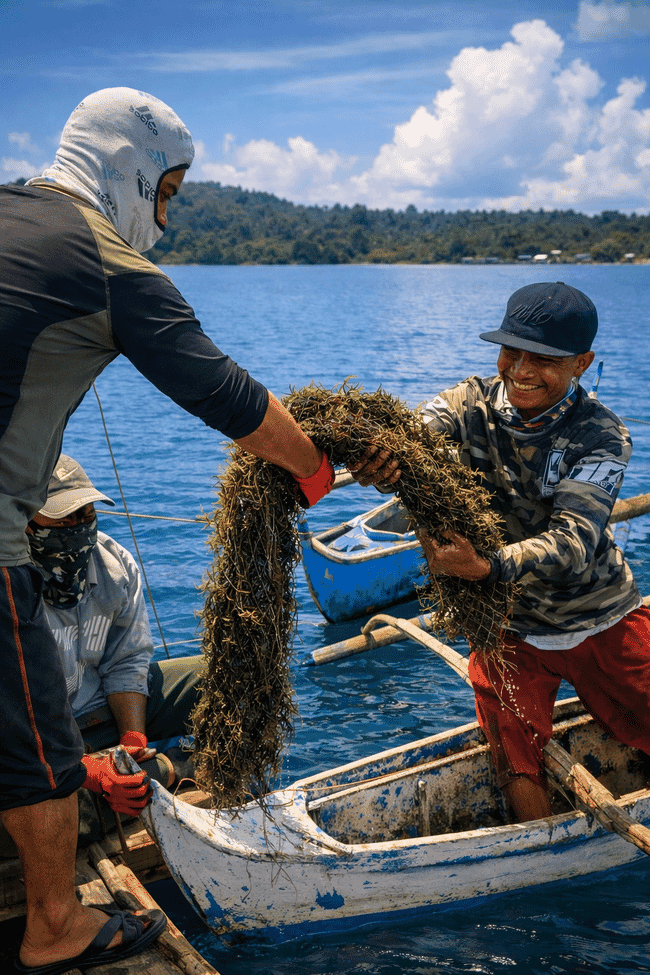
As compliance in tropical supply chains improves – with improved traceability, documentation and quality control – integration into global markets becomes less speculative and more structural. Regulatory alignment and formulation expertise may remain anchored in the West while production will increasingly sit where conditions are best suited.
The future of seaweed is unlikely to be geographically self-contained. It will be geographically integrated. The West holds deep technical and financial leadership, while Southeast Asia holds scalable cultivated biomass.
When inclusion rates rise, biomass elasticity will stop being a background variable and become the defining strategic constraint. Temperate systems will remain essential for innovation, but they will not supply the tonnage required for mass inclusion.


