
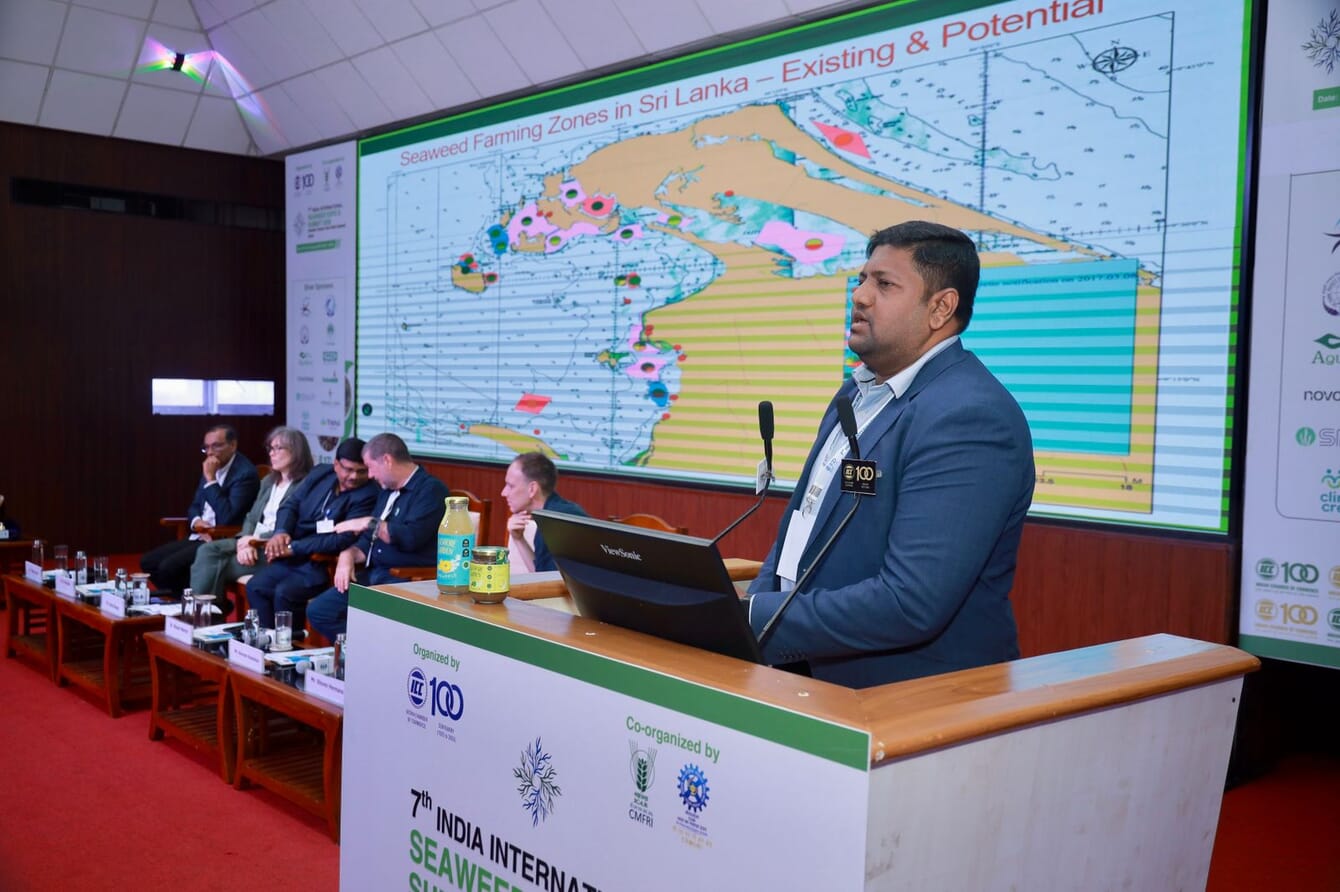
© Kulendran
Representing Sri Lanka and the Maldives as an international panellist, seaweed development consultant Sivaram Kulendran highlighted the region’s growing potential to transition from small-scale cultivation to an integrated, value-added blue economy sector. The summit session titled“The State of World Seaweed – Cultivation, Innovation, Processing, Marketing and Supply Chain”, brought together global experts from Europe, Latin America, Africa and Asia to examine the future of the rapidly expanding industry.
With over 15 years of experience, Sivaram Kulendran traced Sri Lanka’s journey from pilot raft cultivation models introduced in 2012 to more scalable monoline farming systems adopted from 2018 onwards. He emphasised that structured community-based initiatives have created alternative livelihoods for coastal communities, particularly women-headed households.
“Seaweed must now be viewed as a strategic blue economy pillar – integrating climate resilience, livelihood diversification, marine conservation, and export-oriented supply chains,” Kulendran noted during the session.
Maldives signals commercial expansion
The forum also highlighted the Maldives’ first commercial seaweed project, inaugurated under its Ministry of Fisheries and Ocean Resources, alongside a public tender initiative to lease uninhabited islands and lagoon areas for aquaculture operations. The move signals increasing policy recognition of seaweed as a viable commercial aquaculture segment in the Indian Ocean.
Structural challenges and diversification
Kulendran identified climate volatility – including rising sea surface temperatures, salinity fluctuations and cyclonic conditions – as key risks facing tropical seaweed cultivation. Operational challenges such as epiphyte infestations, fish grazing, bulk logistics and storage infrastructure were also cited as areas requiring targeted investment.
He further stressed the need for species diversification beyond Kappaphycus alvarezii, proposing commercially viable options such as Gracilaria, Caulerpa, Sargassum and Padina to strengthen regional competitiveness and broaden value chain opportunities.
From raw exporter to value-added hub
Globally, Indonesia dominates primary production, while China leads in extraction and hydrocolloid manufacturing. However, industry observers note that South Asia and the wider Indian Ocean region are increasingly being viewed as the next frontier of seaweed expansion.
Kulendran argued that Sri Lanka’s strategic geographic location, established coastal communities and expanding aquaculture expertise provide a foundation to move beyond raw material exports towards processing, bio stimulant production, food-grade applications and marine bio-innovation.
“With coordinated policy alignment, private investment, research–industry partnerships and regional trade collaboration, Sri Lanka can emerge as a diversified seaweed hub within the Indian Ocean corridor,” he said in a press release.
As global demand grows for sustainable marine biomass across food, agriculture, pharmaceuticals and climate-linked industries, Sri Lanka’s engagement at the expo underscores its intention to actively shape the future of the regional blue economy.


