
© GreenWave
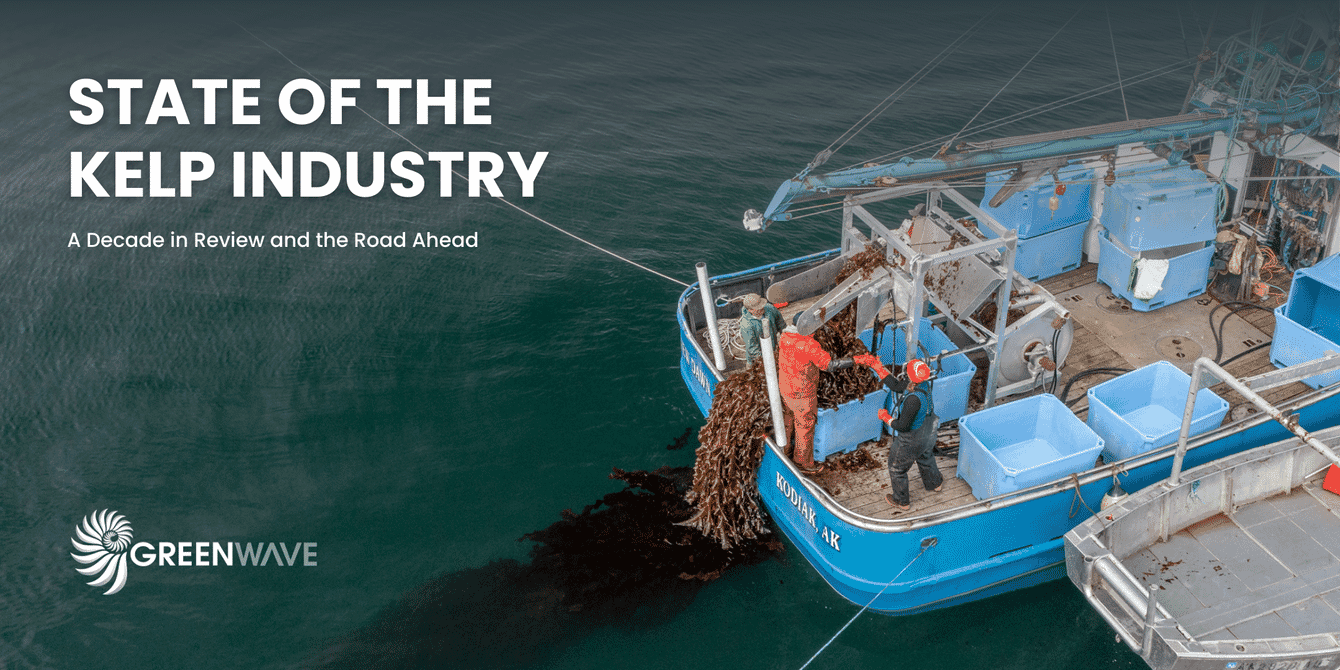
A decade ago, commercial kelp farming in North America amounted to little more than a handful of experimental plots. Today, the US and Canada have nearly 250 permitted farms, more than 50 nurseries, and the capacity to produce tens of millions of pounds of kelp per year. A report published in February by nonprofit GreenWave, State of the Kelp Industry: A Decade in Review and the Road Ahead, examines how the sector has evolved over the past ten years.
The report found that while early investment focused heavily on speculative climate solutions and niche consumer products, the industry is now shifting toward practical, scalable markets where kelp can solve real problems for agriculture, manufacturing, and ingredient supply chains.
"For the last decade, the focus was on building supply. Now it's about turning that capacity into a durable, farmer-led industry that solves real problems – built on real markets, not speculation," said Bren Smith, co-founder and co-executive director of GreenWave.
Market segments identified for growth
The report identifies three market segments emerging as the strongest drivers of future growth: agriculture (particularly biostimulants), functional ingredients for food and personal care, and biomaterials such as nanocellulose. This reflects a broader shift from kelp as a front-of-pack hero ingredient toward a problem solver – replacing petroleum-derived compounds in cosmetics, reducing sodium in processed foods, or offering land-based farmers a domestically produced alternative to wild-harvested seaweed biostimulants.
However, obstacles remain as only 27 percent of farms surveyed reported profitability in 2025. Seed quality – described as "the dominant lever driving the success of the entire value chain" – varies widely, with fewer than 20 nurseries producing most commercial seed. The report highlights controlled propagation using gametophytes as a breakthrough that has improved spool quality, extended growing seasons, and cut nursery labour costs in half at facilities that have adopted the method.
"The data shows that the industry foundation is in place – nurseries, leases, and permits. Processing is starting to connect supply with demand, and markets are taking shape. The challenge now is mobilising that capacity and aligning it with real, scaled demand in near-term markets," said Kendall Barbery, GreenWave's director of partnerships and industry engagement.
Stronger coordination across the value chain
The formation of new cooperatives is flagged as a critical development. Alaska's Kodiak Ocean Growers Cooperative, launched in March 2025 as the state's first producer-led kelp co-op, unites five farmers managing over 300 acres with the capacity to farm more than one million pounds of kelp. The report argues that similar cooperative models, combined with shared processing infrastructure, flexible farmer-forward financing, and engagement from multinational companies, will be essential to turning permitted acreage into a functioning commercial industry.
Despite having built the foundational infrastructure needed to scale, the North American kelp industry remains at a critical inflection point: the next phase of growth will depend on aligning production with real market demand, expanding shared infrastructure, and ensuring farmers remain economically viable as supply chains mature.
Read the full report on GreenWave’s website.


