

© Gurvinder Singh
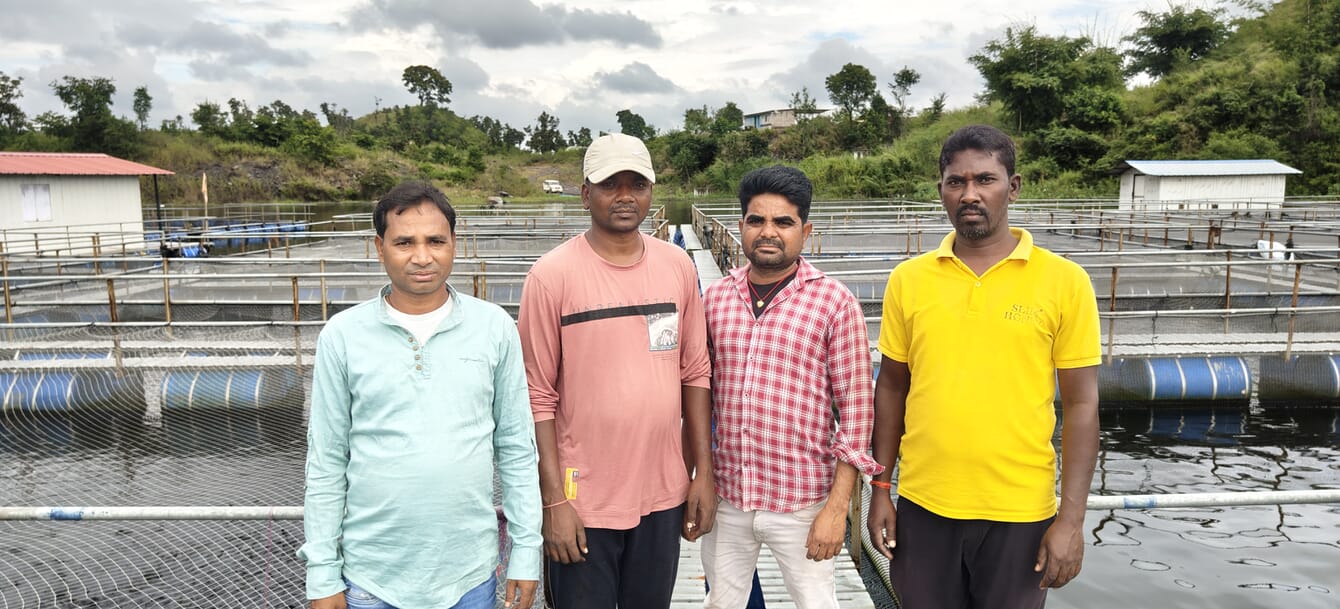
Sashikant Mahto had never imagined that an abandoned coal mine which had once displaced his family would one day produce a livelihood for him.
The 38-year-old lives in the remote village of Ara Basti, in Ramgarh District in the eastern Indian state and now farms a variety of fish species in a mine that was abandoned three decades ago.
After closure the mine was meant to be decommissioned but instead was abandoned. Over time it filled with rainwater and Mahto recalls how he used to catch fish there during his childhood.
The state has around 1,741 abandoned open cast coal mines, most dating back to 1980s and around 26 are currently being used for fish farming.
“In 2010, I started by stocking around 40,000 Indian major carp juveniles and harvested around 100 kg of fish weighing around 500-700 grams in the next six months,” he says.
The turning point, however, came in 2011 when he showed a fish of around 15 kilograms to some senior fisheries department officials, who were duly impressed by his work.
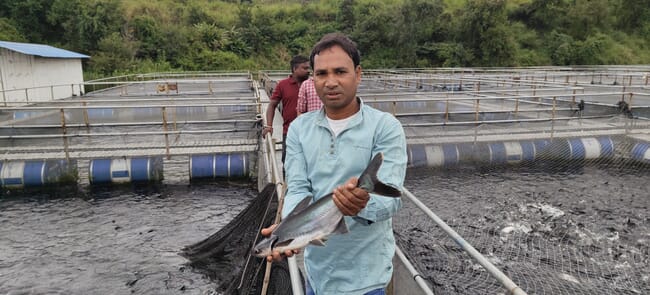
The officials not only gave Mahto a small cash prize for his efforts but also installed a cage farming system for him. Soon, 15 fellow villagers also joined him – initially stocking around 20,000 pangasius fingerlings into the cage.
“We were bit apprehensive about facing losses in the beginning but were guided well by the officials of state fisheries department. We harvested around 80 kg of fish of 500 grams each in the first six months of farming,” recalls Mahto.
The initial harvest was mainly distributed among the members for home consumption but they felt that that the installation of additional cages would add to their income.
© Gurvinder Singh
Mahto took the lead and contacted the senior government officials who agreed to subsidise the provision of more cages.
“The cages are built using GI [galvanised iron] pipes, fabricated twine ropes and nets and provided completely free to the farmers. The entire structure floats on high-density polyethylene (HDPE) drums. The seeds are also offered free for one year to the first-time farmers. The fish are fed with formulated market feed,” explains a senior official from the department.
In 2015 Mahto helped to found the Kuju fishermen Co-operative Society and it now has 61 members.
Two years later, farmers started culturing monosex tilapia in the cages while they also reared carp outside the cage area.
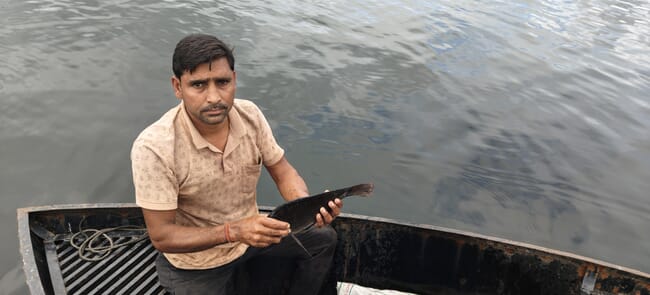
The fish are much darker than those farmed in conventional ponds, due to the presence of coal in the lakes © Gurvinder Singh
The original mine has a total area of 32 hectares of which 9 hectares is being used for cage farming, with 77 8 m x 6 m cages installed. Meanwhile a second abandoned mine of around 3 hectares has had an additional 42 cages 12 m x 8 m installed.
The total collective production from both the mines currently stands at 130 tonnes, which is both consumed domestically and exported to the neighbouring state of Bihar.
According to the farmers, there have been no major mortalities in the farms so far, although the fish are very dark in colour due to the coal residue.
Mahto explains that farming in the mine offers a livelihood to locals and brings wasteland into use.
“We were evicted from our homes when the mining started here around six decades ago and also suffered due to pollution from the mine. The fish farming has offered locals an alternative to make use of the useless land, while it has also been offering livelihoods to 60 families settled in the village,” he said, adding that each member of the co-operative society earns around $135 per month.


