© Oyster Heaven
Once one of the most common forms of seafood in the UK, the country’s native oyster populations are now a mere shadow of their former abundance. At the peak of the golden age of oyster exploitation during turn of the 19th century, the 2 million strong population of London are thought to have consumed about 800 million oysters per year - that’s more than 400 per person.
Following decades of over-harvesting, combined with increasing marine pollution, disease, and habitat loss, it is estimated that the UK’s native oyster populations have declined by as much as 95 percent since the mid-19th century. They are now functionally extinct and an OSPAR Red List species.
Whilst it could be easy to get lost in a spiral of despair over humanity’s heavy impact on our oceans and their inhabitants, Founder George Birch has identified an opportunity for innovation, and a chance to change the way we think about mitigating our environmental footprints.
A low tech approach
Whilst Birch admits that his passion for biology began as a slow burn, Oyster Heaven has established itself with impressive rapidity. Beginning only a little over three years ago, the organisation has already developed, and successfully deployed, a unique structure for promoting the regeneration of native oyster reefs. With multiple pilot projects now completed and demonstrating strong ecological results, his team is shifting from proof-of-concept to scaled implementation.
One of the main challenges faced in the regeneration of oyster populations, Birch explains, is in providing a suitable substrate to facilitate oyster settlement, whilst also meeting the stringent regulatory requirements applied to restoration projects.
“The first challenge is getting permission to put oyster restoration projects in the water. Ultimately, the rules were made at a time where active restoration did not exist,” George says.
“You have to jump through the same set of hoops as an oil and gas platform, which is incredibly challenging, it is a negative marking system and it completely fails to look at the hundreds of new species that might be brought back by the restoration.”
Many other oyster reef regeneration projects rely on the use of old oyster shells as a settlement substrate for new populations but, whilst this works well for settlement, the finite availability of spent shells and lack of stability and structure on the seabed makes this approach difficult to implement on a grand scale.
They can be a difficult resource to get hold of, Birch explains, and, even if you do have a reliable supply, there are then a host of biosecurity issues which need to be addressed before they can be transplanted into a prospective reef site.
© Dutch Maritime Productions
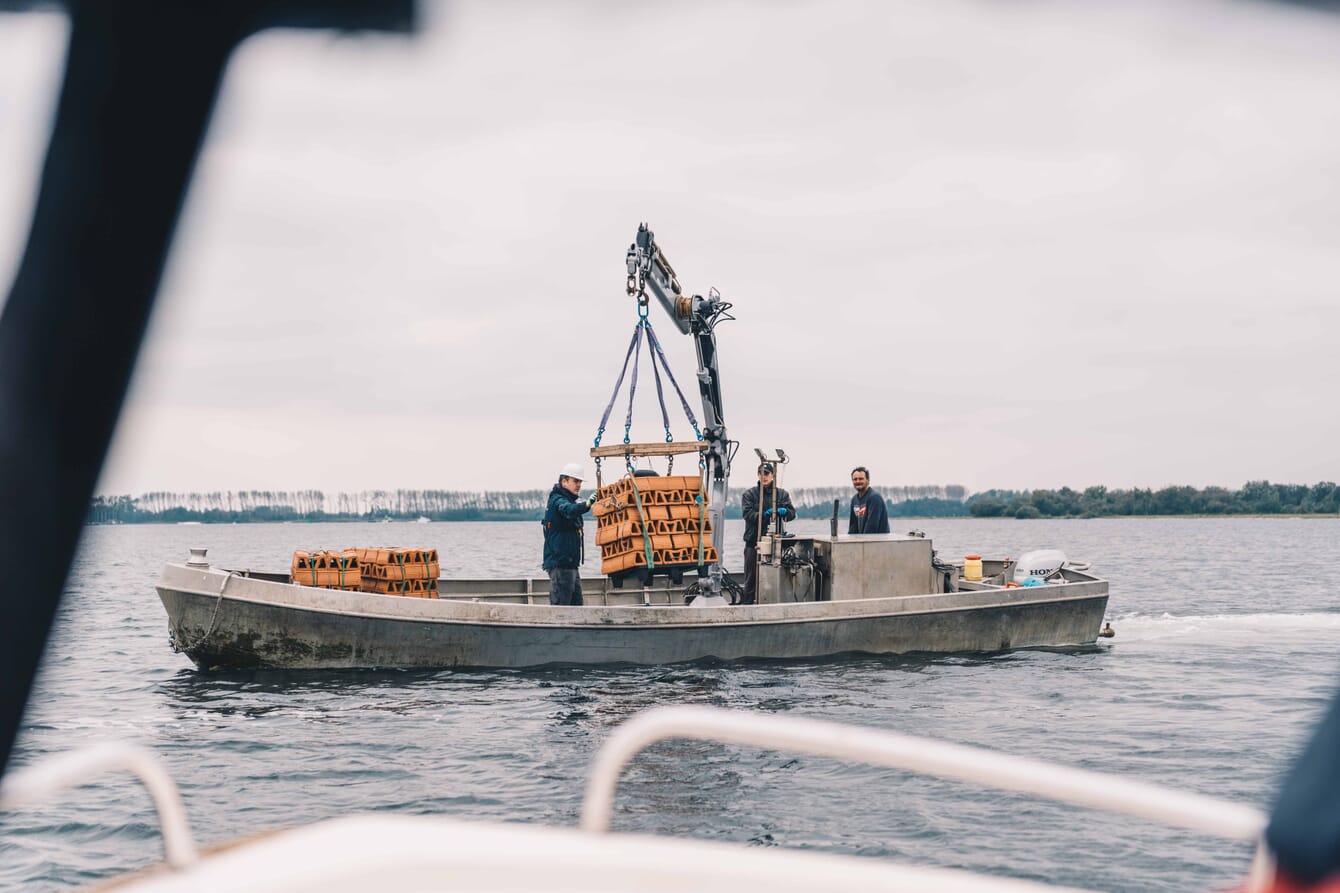
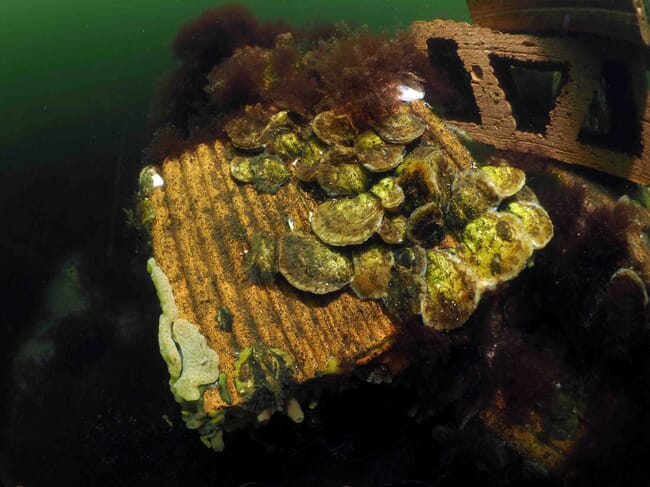
Seeking to provide an alternative, Oyster Heaven’s approach to reef restoration relies on a simple clay design, barely discernible from a regular construction brick to the untrained eye. However, despite its innocuous appearance, this unique technology is the fruit of much careful research and development, resulting in a reef substrate optimised to provide structure for just the required period of time before it degrades, leaving nothing except a thriving oyster reef.
“Clay is a wonderful material because it's natural. It's one of the most ubiquitous materials on the planet and all that we're doing is heating it. When you heat it to low temperatures, clay erodes in the water over a predictable period of time. So, if you want your reef scaffolding to last two years or 20 years or 200 years, we can do that. It just depends on the temperature you fire it at,” Birch explains.
Due to the simplicity of Oyster Heaven’s substrate design, Birch estimates that any common brick factory with the correct technology could produce up to 240,000 of these bricks per day. Whilst the process of attaching oysters and deploying the reef structures does raise the production cost a little, he estimates that this framework for restoration costs roughly €0.25 per oyster.
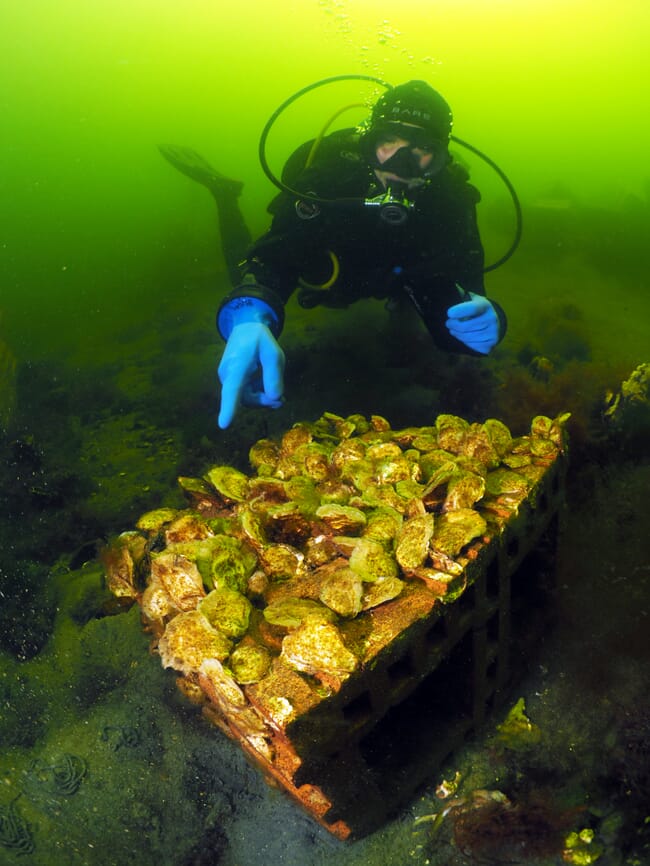
So far, the technology seems to be a success, with the company having six seawater pilot sites around the coasts of the US, England, Belgium, Netherlands, Spain and Denmark – each chosen given their historic oyster populations. These pilot sites each cover 1500 m2 and constitute three generations of recruitment. In deployment, the team allows for a highly conservative 90 percent loss rate, but this is never reached, and each reef is populated with an estimated 400,000 oysters which, so far, seem to be thriving.
© Oyster Heaven
Credit where credit is due
Whilst Birch is confident in the technology his team has developed, he expresses surprise at the apparent lack of flexibility and creativity within the blue investment world. For a project such as this to work, the company needs supportive partners but, according to Birch, many investors cannot comprehend environmental restoration projects that are not boldly painted with the words “blue carbon.”
Part of the solution to this, he argues, is to develop an entirely new system for the selling of resilience services – such as those provided by oysters.
It would be very hard to sell the idea of a raw biodiversity credit, Birch explains, as it is difficult for people to understand what that would actually translate to. An alternative to this, which he envisions for the future, would be the selling of impact management services to companies to address specific problems. The company would then be able to calculate and quantify the reduction to their impact this service has caused.
Birch has hopes that, in this respect, his company’s technology could be applied to the aquaculture industry. He explains his vision for the integration of oyster cultivation with commercial finfish farming in order to mitigate the emission of excess nutrients common to such operations.
“What we want to do is start looking at how we can wrap pens with oysters, which can help reduce ecological loading by filtering out excess nutrients from the water. Maybe it can even reduce the spread of pathogens,” he explains.
In the meantime, until such a credit system can be developed, Oyster Heaven has already acquired some significant partners, such as Nestle Purina, with whom they are part of a project to restore 1,500 hectares of marine habitat by 2030. Through their first project they deployed 4 million oysters in the Netherlands in 2025, which is currently the largest native oyster reef restoration programme in Europe, and their recently launched project in the UK is set to surpass it in scale.
Through the partnership they are also working on a research and development basis to investigate the practical, financial, social, environmental benefits of restoring oyster reefs, as well as a set of other habitats. Oyster Heaven also raised working capital financing from Rebalance Earth, one of the managers of the West Yorkshire Pension fund, meaning there is pension fund money going into the rebuilding of oyster reefs in North Norfolk.
Plans for the future
Birch has big plans for the future of the company in which it would step back from the actual physical restoration of oyster reefs, instead focusing on the demonstration and licensing of its technology for other organisations to use.
“We want to have a couple of demonstration projects in every region, and then what we want to do is to provide consulting and licences for our technology so that people can develop their own reefs. For example, we could work with a local river trust that wants to put an oyster reef at the end of a river, and we would provide the methodology and the system to do this.”
Whilst these plans are still very much in development, Birch’s obvious passion and enthusiasm for the project is very much infectious and, based on the startup’s rapid progress over the last couple of years, it seems like, for this company, the world is its oyster.
© Oyster Heaven