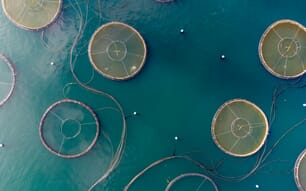
© HanseGarnelen
HanseGarnelen runs what is currently the largest operational clear-water shrimp recirculation aquaculture systems (RAS) farm in Europe, producing around 100 tonnes of Pacific white shrimp (Litopenaeus vannamei) a year in Glückstadt, northern Germany. After a brush with insolvency and a change of ownership, the company is betting on automation, local branding and continuous improvement to make “German shrimp” a viable alternative to imports.
“Growing shrimp in Germany was a really bad idea,” jokes HanseGarnelen’s founder, Rupert Baur, remembering his decision to build a tropical shrimp farm in the country. The engineer had initially started his career in RAS on the other end of the spectrum, setting up a company to sell RAS farms in Central and South America, where climatic conditions are ideal for shrimp.
“In Mexico, all you have to do is open and close the window, depending on whether it's summer or winter,” says Baur. “In Germany, we have a big building and we have to heat it in the winter and we have to cool it in the summer.”
Baur’s original company, MyFishPlant, attracted curious investors, but to move forward, they first wanted to see that the RAS systems worked in practice.
“They all said they want to see a showcase in Germany. If that's German technology, they want to see something here,” he recalls. “So, I came back from Mexico and was searching for investors. In 2019, I found some investors to build a first plant here in Germany.”
Baur started the new company, HanseGarnelen, with the intention of using it as a showcase for MyFishPlant’s technology, a showcase that has since grown into one of the largest operational shrimp RAS facilities in Europe.
Focusing on Glückstadt after insolvency
The showcase concept has not been without setbacks. HanseGarnelen originally operated a small demonstration site along with another modest facility, but rising construction costs and the loss of a key investor pushed the group into insolvency in June 2025.
“Before [insolvency] we had one very small farm just as a proof of concept… and we bought another one,” Baur explains. “But these two small plants are closed now. And now, besides the biofloc-plant of the new investor Damm Aquakultur GmbH & Co. KG, we concentrate on the big plant here in Glückstadt.”
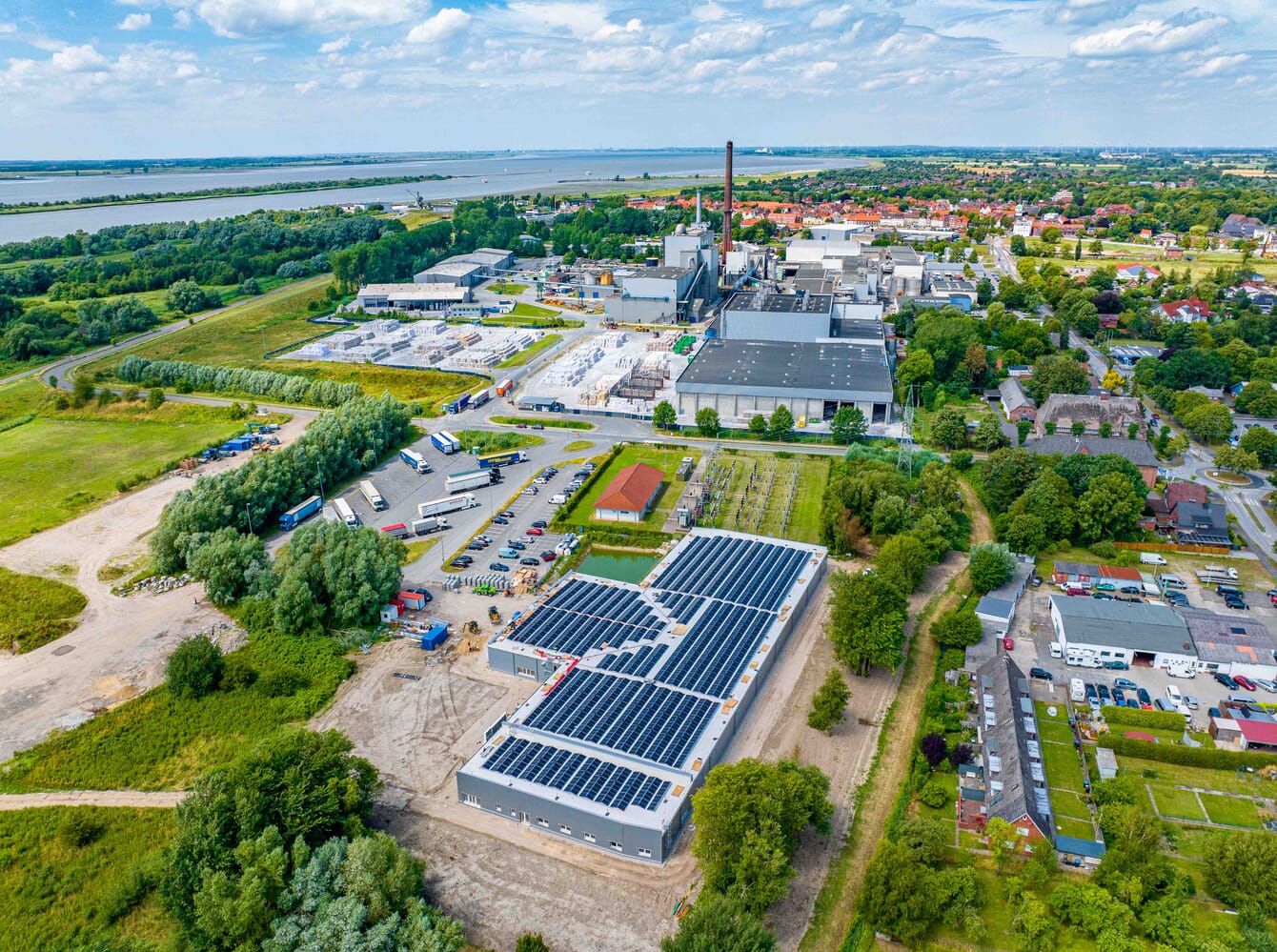
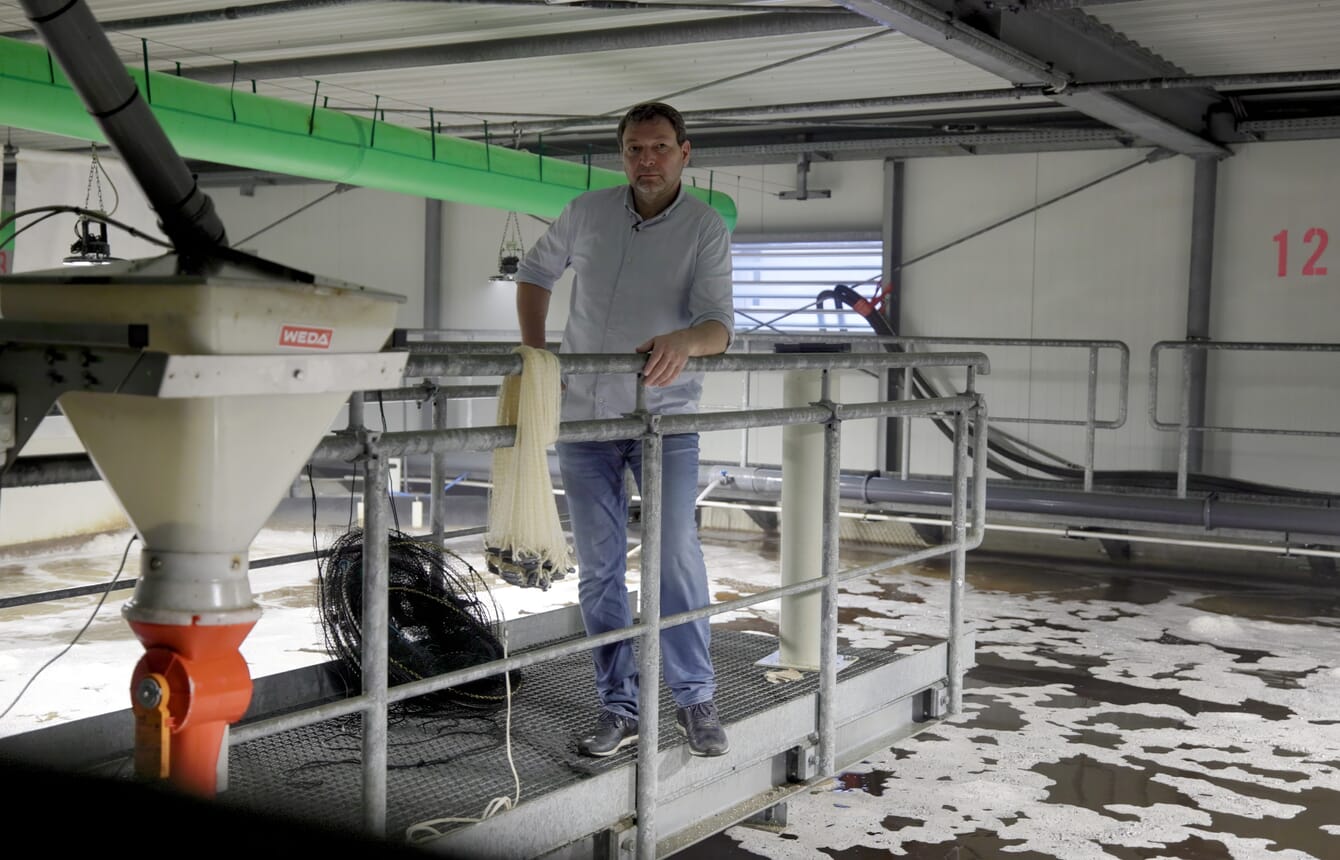
The Glückstadt facility is roughly the size of a football pitch, with around 5,000 m² of floor space and 4,000 m³ of water in its tanks. The farm uses a clear-water RAS, with 13 dedicated tanks for juveniles and 13 for grow-out. Shrimp are moved once during production, with each grow-out tank stocked and harvested four to five times a year, depending on growth performance and market requirements.
Shrimp postlarvae are sourced from multiple hatcheries to maintain genetic diversity and arrive at the farm at stages PL10 to PL12. A usual growth cycle takes around 90 to 120 days. The water is sourced directly from the river Elbe, and nearby paper mill waste heat is used to heat it up, with the rest of the energy being supplied by solar power.
© Uri Magnus for Hatch Blue
Baur argues that overall energy use is low thanks to this setup. “We have a very low use of energy,” he says. “The carbon footprint of the shrimp is also very low, it's nearly zero.”
The business model now rests squarely on this single site and its ability to supply a steady volume of shrimp to German retailers and foodservice buyers. After the insolvency process, new owners stepped in, while the operational team and technical concept remained largely unchanged.
“Now we are under new ownership and we have a stable running business,” Baur says. “We will be able to live well off our sales in the future.”
HanseGarnelen is operating in a market where imported shrimp still dominate. The large majority of shrimp consumed in Germany come from abroad – mostly the Americas and Asia – and are typically farmed in open ponds in tropical regions and shipped frozen.
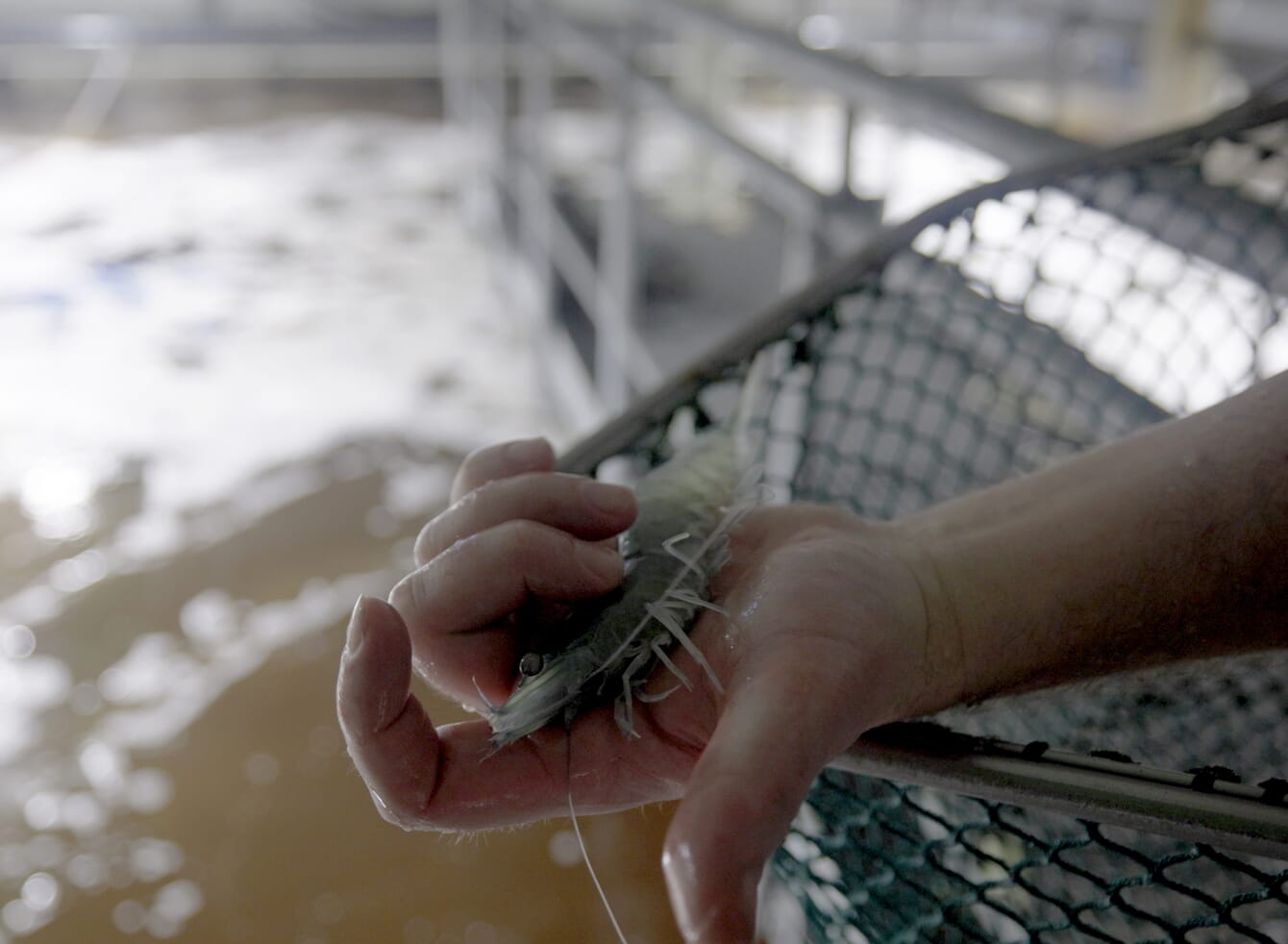
The company, competing directly with these imports, positions its product as a local, high-quality alternative: “German shrimp” produced without antibiotics, processed on site and sold either fresh or shock frozen. The farm handles grading, peeling and packaging in-house, supplying a mix of easy-peel and peeled products for retail and gastronomy.
With consumers increasingly attentive to animal welfare, traceability and environmental impacts, demand for local shrimp is rising and retailers are under pressure to demonstrate responsible sourcing along their seafood shelves. A closed, land-based RAS with full control over water quality, inputs and effluents fits neatly into this narrative.
Price, however, remains a challenge for any European shrimp RAS project. HanseGarnelen’s shrimp are more expensive per kilo at the point of sale than many imported alternatives. Baur counters this by focusing on yield and quality.
“If you put our shock frozen shrimp in the pan, you will get the same shrimp back,” he says. “With imported shrimp, you might get only one quarter back because up to 75 percent are water. That means you have to multiply the cost… by a factor of three to four and then you have to compare the quality.”
The company is also working on third-party recognition of its practices. EU organic certification is structurally out of reach for tropical shrimp species grown in Germany, because the habitat criteria were designed for other production contexts. Instead, HanseGarnelen is aiming to purse Aquaculture Stewardship Council (ASC) certification as a more realistic next step for market differentiation.
Feed is sourced from suppliers in Germany and France, and the farm emphasises both the regional supply chain and the closed-loop nature of the system when talking to buyers. For farmers and investors, the strategy illustrates how local provenance, process control and product performance can be combined to justify a premium, even when competing against mass-produced imports.
© Uri Magnus for Hatch Blue
Modernising the farm and planning for the future
The farm is built on established RAS principles – mechanical filtration, biofiltration and oxygenation – but the monitoring and control systems are steadily becoming more sophisticated. HanseGarnelen has already implemented automated shrimp counting and is exploring broader use of cameras and artificial intelligence (AI) to reduce manual checks.
One camera, Baur explains, can be configured to monitor several parameters at once by defining different zones within the image: water level in a tank, foam formation on the surface, or whether a tank is full or empty. Combined with software to interpret those images and trigger alarms, a single sensor can provide effective oversight of what is happening in the tanks.
“We continue to get more and more automatic systems here in Glückstadt,” he says. The long-term goal is to improve reliability and reduce labour input while maintaining strict oversight of animal welfare and water quality.
HanseGarnelen’s trajectory from “bad idea” to one of Europe’s largest operational shrimp RAS farms shows both the potential and the pressure points of indoor shrimp production in temperate climates. The company has survived a restructuring, consolidated its operations and now leans on local branding, process control and automation to carve out a place in an import-heavy market.
“The main challenge is the market has to be developed because everybody knows the imported shrimp and nobody expects to get fresh shrimp from Germany,” Baur explains.
Aside from marketing, Baur identifies another challenge, one that is inherent to working with live animals.
“Every animal behaves differently, so every batch behaves differently to the one before,” he says. “You have to keep adjusting your process – not every day, but tightening the limits you work within – to make everything smoother and more consistent from batch to batch. Some batches grow faster, others more slowly, and you always have to adapt.”
Those market and biological uncertainties are exactly why Baur wanted a robust showcase for his technology in the first place. In that sense, HanseGarnelen has become the proof of concept for MyFishPlant’s idea. If a clear-water shrimp RAS can hold its own in Germany’s climate and cost environment, Baur believes the same model could be even more competitive in other markets worldwide.