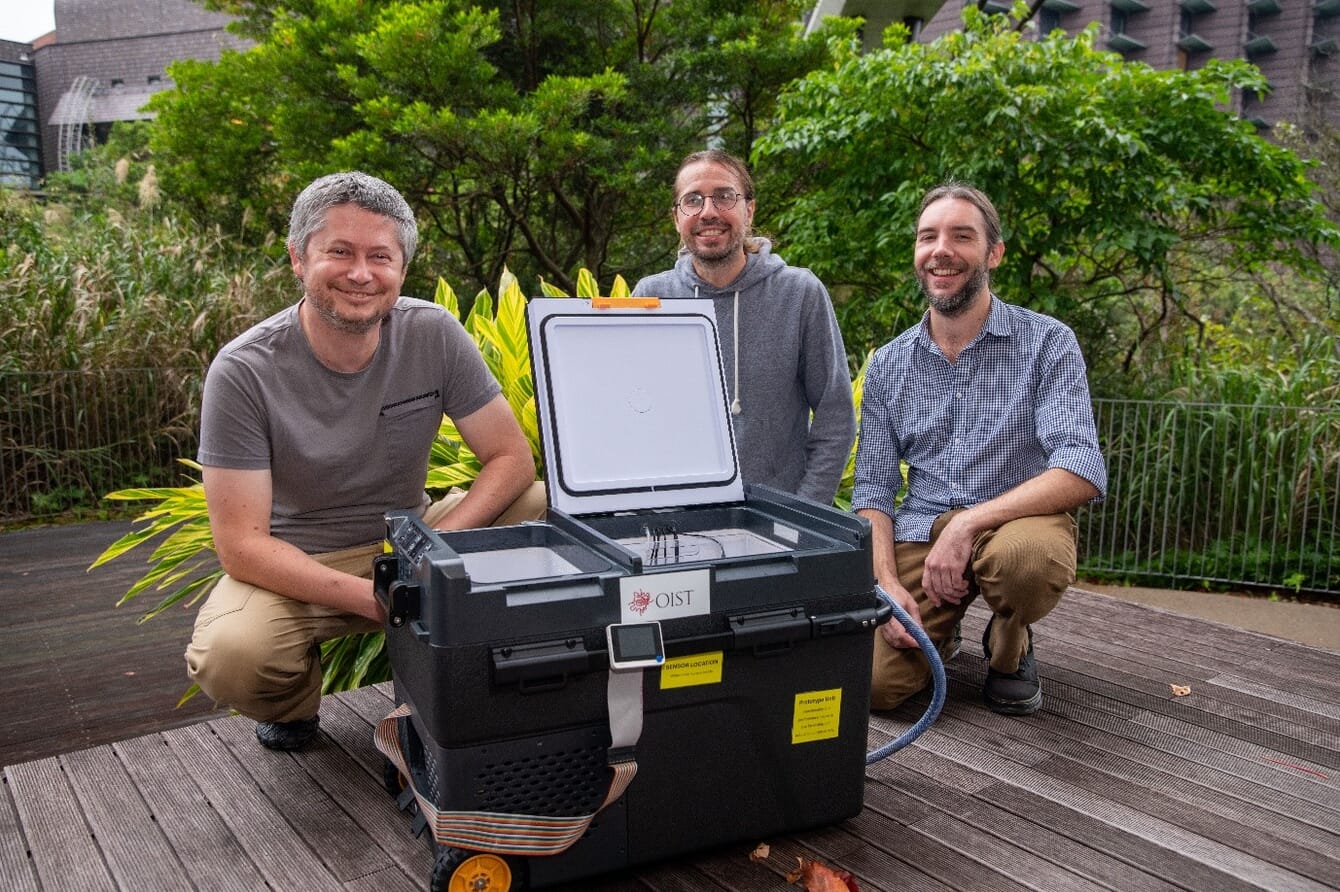
Left to right: Dr Peter Babiak, Dr Zdenek Lajbner and Dr John Parker, who contributed to its development © Andrew Scott, OIST
By automating the hatching and transfer phases using light and water flow, the system aims to minimise pathogen exposure, animal stress and labour input across the multi-billion-dollar industry.
The global aquaculture sector produced an estimated 94.4 million tonnes of aquatic animals in 2022 alone. However, productivity remains limited by early-life bottlenecks, with high mortality rates caused by disease, environmental changes and stress. To address this, a team from OIST has developed a scalable aquaculture platform which automates the sensitive phases of aquaculture – hatching and transfers – which can minimise pathogen exposure, animal stress and labour input.
Developing a scalable automated aquaculture system
The system was originally developed to support cephalopod research at OIST, where culturing squid and octopus is particularly challenging.
“Cephalopod hatchlings are extremely sensitive to direct manipulation,” said project leader Dr Zdenek Lajbner in a press release. “Guiding them using light and water flow allows us to improve survival while reducing stress and labour.”
The team composed of Zdenek Lajbner, Ryuta Nakajima, Mehmet Arif Zoral, Peter Babiak, John Parker, Mouez Lassoued and Jonathan Miller, designed a modular prototype, successfully testing this on multiple cephalopod species before recognising the broader relevance of their system. “Any aquatic species whose early life stages respond to light and flow, including fish and shrimp, can be maneuvererd using the same principles,” added Dr Lajbner.
By using a light and flow approach, they could eliminate handling-related stress by encouraging animals to move autonomously, improving welfare outcomes. The team also integrated IoT-enabled sensors to continuously monitor key environmental parameters, including temperature, salinity, and oxygen levels. These provide real-time data and alerts to remote users. With automated, detailed, real-time characterization of each transported individual, immediate automated decisions can be made based on the information obtained.
“Our modular design enables the systems to be integrated into existing facilities, used as standalone recirculating units, or configured as mobile systems,” added Dr Lajbner.
With integrated AI for automated counting, size-based sorting, behavioural monitoring, and health assessment, the platform could enable early-stage evaluation of stock quality.
Standardising early-life handling and assessment could also help facilities shift from labour-intensive and subjective manual observation toward fast, accurate, data-driven decision-making.
Enhancing welfare while improving productivity
Animal stress during hatching and transfer is an important contributor to mortality and long-term aquaculture performance deficits. From an operational perspective, even modest improvements in early survival can have outsized economic effects, and reduce wasted feed, labour hours, and tank downtime.
“With global aquatic food consumption having increased by more than 480 percent since the 1960s, and growing pressure on wild stocks from climate change and overfishing, scalable automated aquaculture technologies are essential,” said Dr Lajbner. “We estimate that a 15-25 percent increase in early-stage survival can significantly improve effective output at farm scale.”
The OIST team is now seeking industrial partners to validate the system in commercial hatcheries, expand species testing, and scale the platform for large-scale aquaculture operations.