© Pep4Fish
Funded through Portugal's Recovery and Resilience Plan (PRR) under the EU post-pandemic recovery framework, the Pep4Fish project is testing novel feed formulations under commercial production conditions for the first time. The trials aim to enhance fish resilience against stress and bacterial infections, reduce economic losses, and improve end-product quality. With global aquaculture currently supplying half of all fish consumed worldwide, the project seeks to make Portuguese aquaculture production more sustainable and less dependent on finite, conventional feed ingredients.
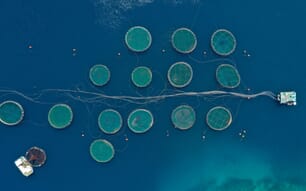
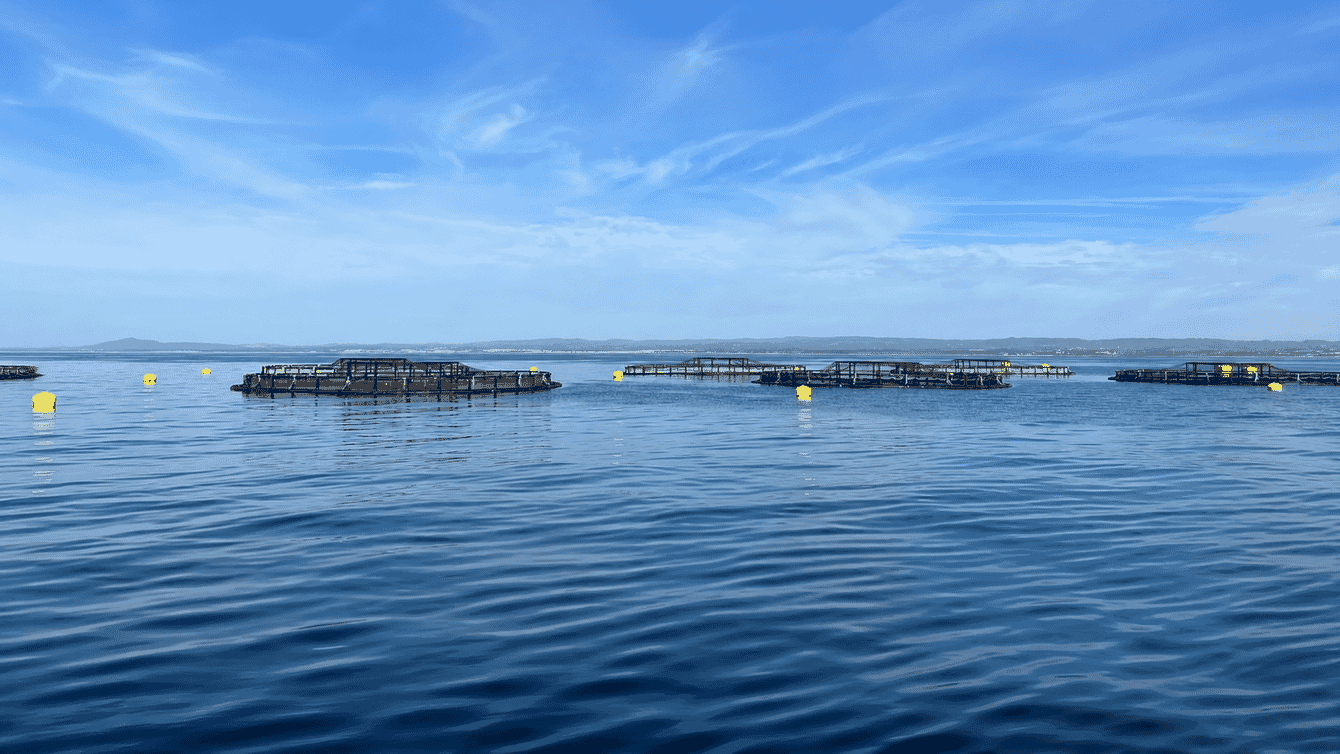
The trials are taking place at Seaculture, a Jerónimo Martins Agro-Alimentar company and consortium partner, which acts as the project's final demonstrator, assessing the performance of these new formulations under real aquaculture production conditions at its offshore aquaculture facility in the Algarve.
"We are evaluating fish performance with these new diets in a production environment, as initial laboratory results point to very positive indicators, particularly in terms of growth and reduced mortality rates," said Pedro Encarnação, executive director of Seaculture, in a press release.
Under evaluation are experimental diets enriched with new protein hydrolysates, innovative ingredients obtained by breaking down proteins from underutilised resources into compounds that are easier for fish to absorb. In simple terms, they work as advanced nutritional ingredients that help strengthen fish health, robustness and growth, while promoting more sustainable aquaculture feed in a circular bioeconomy logic.
For Seaculture, this phase marks the transition from research to practical application, demonstrating how innovation in aquaculture nutrition can help address key industry challenges such as production system resilience, ingredient sustainability and fish quality.
Circular economy at the core
One of Pep4Fish's central ambitions is to reduce dependence on conventional raw materials by promoting more sustainable alternatives and strengthening circular value chains. By incorporating high-value ingredients derived from underutilised resources, the project seeks to contribute to an aquaculture sector that is less reliant on finite resources and more aligned with circular economy principles.
"This project allows us to explore solutions that strengthen production sustainability while also promoting animal welfare. We believe that more robust and healthy fish also translate into a higher quality end product," added Encarnação.
The Pep4Fish consortium unites nine industrial and scientific partners: AgroGrIN Tech, B2E CoLAB, CIIMAR, the School of Biotechnology at the Portuguese Catholic University, ITS, Savinor, Sebol, Sorgal, and Seaculture. Operating under the national Blue Bioeconomy Pact, the group focuses on developing new aquaculture feed solutions that combine innovation, sustainability and resource valorisation, promoting more efficient production aligned with circular bioeconomy principles.