
© CEPAM-ECOMARE
The findings, developed under the PUFApods project, offer a sustainable, circular pathway to reduce the dependence of the aquaculture industry on finite wild fish stocks for essential fatty acids.
As the global aquaculture sector expands, securing sustainable sources of essential nutrients – particularly omega-3 long-chain polyunsaturated fatty acids (LC-PUFAs) such as EPA and DHA – remains a critical bottleneck. While these nutrients are traditionally sourced from wild marine life, the industry is shifting toward nutrient diversification. Led by CEPAM-ECOMARE at the University of Aveiro, the PUFApods project aligns with this transition by exploring whether plant-based crop waste can be successfully upcycled into high-value marine nutrients.
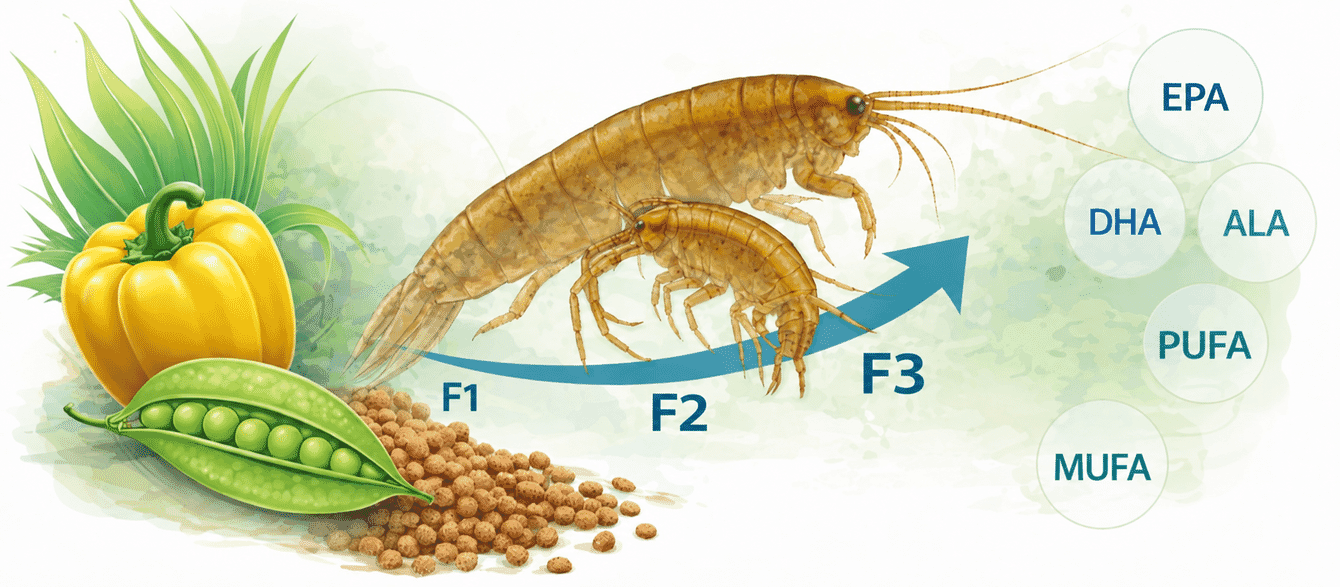
The research team focused on Gammarus locusta, a species of marine amphipod. As natural detritivores, these organisms are capable of performing a trophic upgrade of their diets; in other words, they can feed on agricultural residues and transform diets lacking EPA and DHA into a biomass rich in these two essential fatty acids.
Recent findings show that these organisms can be reared on these vegetable by-products while maintaining relevant levels of EPA and DHA over consecutive generations. Ultimately, the real breakthrough lies in understanding this long-term generational behaviour, opening the door to nutritional programming in commercial farming and providing a novel, low-cost and sustainable ingredient for aquafeed formulation.
What happens over multiple generations?
To evaluate the commercial stability of an amphipod production system, PUFApods tracked the fatty acid profile of Gammarus locusta across three consecutive generations (F1 to F3). The organisms were fed purely plant-based diets – specifically peas and bell peppers – and compared with a control group fed standard fish feed. The main findings can be outlined as follows:
- Diet dictates reproduction: Amphipods fed a control fish feed reproduced faster and more efficiently across all generations. Those on some plant diets showed a drop in reproductive performance output and a delayed sexual maturation by the third generation (F3).
- Not all vegetables perform equally: Pea-based diets supported relatively stable, reliable reproduction over multiple generations with a reproductive performance comparable to the control, whereas bell peppers caused reproductive key points to drag significantly.
Biological mechanisms and lipid synthesis
Biochemical data found the amphipods successfully maintained essential n-3 LC-PUFA (EPA and DHA) levels, even when these nutrients were absent from their diet. Key insights into how their biology managed this include:
- Trophic upgrading is clearly proven: Even when solely provided with plant waste, the organisms actively transformed a diet lacking marine lipids into a nutrient-rich biomass, featuring relevant levels of omega-3s (including EPA and DHA).
- Metabolic flexibility is the mechanism: The data strongly suggest that Gammarus locusta can synthesise these lipids de novo.
- Distinct fatty acid behaviours: EPA and DHA do not behave the same way under nutritional stress. EPA levels were highly variable and directly responsive to diet, whereas DHA remained remarkably stable across multiple generations, suggesting a more stringent metabolic regulation.
The PUFApods project also investigated how parental diets influence offspring, an important consideration for commercial broodstock management. The findings show that parental nutrition shapes both the fatty acid composition and resilience of subsequent generations. In particular, maternal provisioning establishes the offspring’s baseline fatty acid profile, as the composition of unfed, newly hatched specimens directly reflects the nutrients invested by the mother.
In practical terms, this means that commercial feeding strategies must look beyond a single generation and account for trans-generational effects, particularly the influence of parental diets, to maximise offspring performance.
Implications for sustainable aquaculture
The ability of Gammarus locusta to convert crop waste into valuable marine biomass offers three key advantages for the sector:
- It reduces reliance on wild-caught marine resources, protecting ocean food webs.
- It adds value to agricultural waste streams, supporting circular bioeconomy principles.
- It fosters the links between terrestrial food ecosystems and marine food ecosystems.
According to the researcher team, marine amphipods can be easily integrated into existing Recirculating Aquaculture Systems (RAS), Integrated Multi-Trophic Aquaculture (IMTA), and traditional pond-based production. Their ability to thrive using organic waste streams as a food source allows farmers to achieve an extra high-value biomass crop without having to employ any major modifications of their farming infrastructures.
Click here for more information about the PUFApods project.


