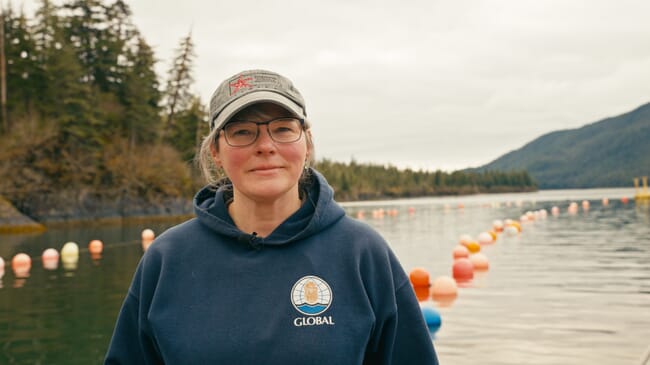
Originally from out of state, Gehlbach moved to Cordova to work as a biologist for the Alaska Department of Fish and Game. “I just really loved the community of Cordova and met my husband [Andy Craig]. He was also working at Fish and Game,” she explains. “We decided we wanted to stay and try other things.”
The couple explored multiple ventures – her husband fished and Gehlbach ran a kayak outfitting business – before deciding to move into mariculture, in 2019.
“In order to stay working on the water with myself and my son, I was like, how can we still stay connected to the commercial seafood industry in Cordova and keep me working on the water? So we started talking about maybe buying a shellfish farm,” she recalls.
Instead they decided to start their own farm from scratch, helped by industry veteran, Jim Aguilar, formerly of Eagle Shellfish.
“He helped me choose a new location and really helped me figuring out the equipment,” Gehlbach says. “I spent some time working with him and kind of learned what to do.”
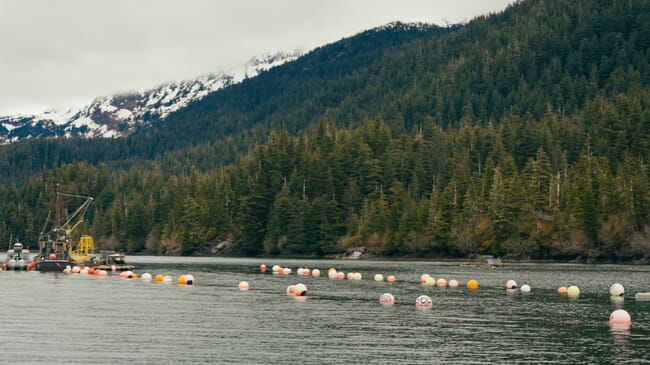
The farm’s location was carefully chosen for its unique natural advantages – including protection by a nearby point and a reef.
“I’m really tucked in back here and I don’t get any wind. It can be just blowing and windy and the water can be really lumpy out front, and back in here, it’s very calm and lovely,” Gehlbach reflects.
The site’s currents also provide a steady nutrient flow, which is critical for oyster growth. Equally important to Gehlbach is that it doesn’t overlap with an area of established commercial fishing activity, helping to ensure social licence for the venture.
Keeping it in the family
The farm is intentionally small and designed for simplicity – allowing the company to remain family owned and operated.
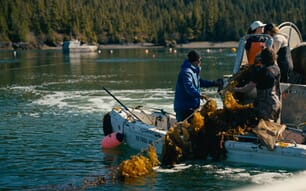
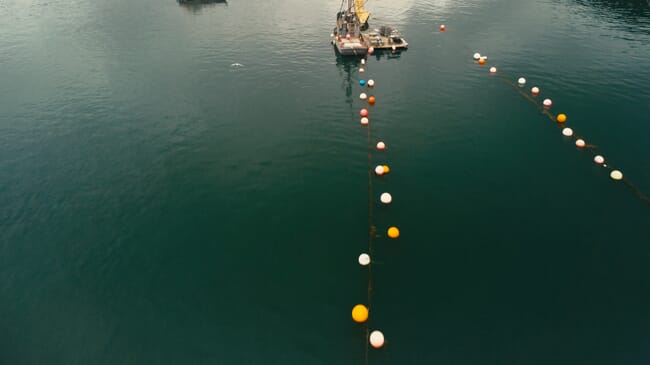
“I have two long lines with grow-out gear for my oysters,” Gehlbach explains. “This work deck, I have a little tumbler, and then I have these stacks that I’m growing out the oysters in. It’s all hanging gear.”
She uses a winch to hoist the oyster trays from the water, wash them, tumble them and grade them.
Gehlbach sources her spat from Eric Wyatt, of Blue Star Fisheries, so she can concentrate on on-growing.
“I was advised as a new farmer to get the biggest seed I can,” she says. “That way I’m not doing any of the nursery work. I’m just putting oysters straight into my trays and putting them out onto the farm.”
Market size is typically reached in about three years.
“Sometimes I’ll have oysters in the second year that are strong enough,” Gehlbach says. “But three years is about average.”
Building a local market
Although Gehlbach initially sold her oysters to wholesalers in the state capital, she’s now focused on selling locally.
“I tried doing [Anchorage wholesale markets] my first year… and that wasn’t very satisfying for me because I didn’t see any of that customer base,” she says. “The following year, I decided I really wanted to base more of my sales out of Cordova.”
Simpson Bay oysters are now a staple at local restaurants and lodges during the summer, and are also sold direct to consumers.
“I just do a pop-up when I do a harvest,” Gehlbach says. “I’ll say, hey, pre-order, I’m harvesting next week … and I sell direct to the public. And that’s been awesome. I really like that. I really like interacting with the community that way.”
The farm’s oysters are also shipped to nearby coastal towns like Yakutat and Valdez, which don’t have local farms.
“It’s really nice to be able to provide oysters to other coastal communities near us,” Gehlbach reflects. “Anchorage has access to other choices, so I really like providing oysters in my local region.”
And despite the state’s sparse population, demand is high.
“I could sell a lot more oysters,” Gehlbach admits. “There could be more oysters produced in Alaska – we need more oyster farmers.”
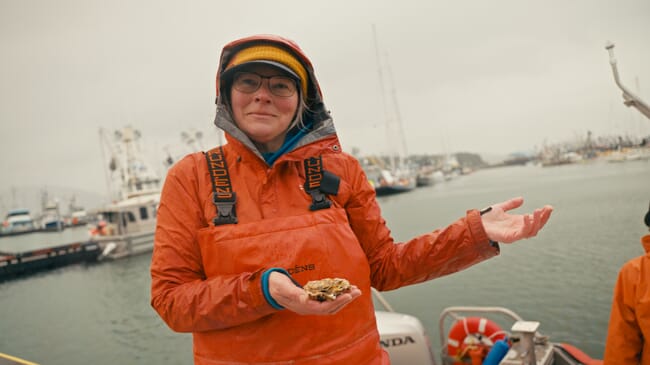
However, while there’s potential to expand the farm, Gehlbach is committed to keeping it manageable.
“My goal… has really been to keep myself and my son working on the water,” she explains.
Gehlbach also values the farm’s role as a platform for research and education.
“I’ve enjoyed being a part of some research projects through the University of Fairbanks and the Prince William Sound Science Center,” she explains.
Gehlbach is also keen to educate and inspire the younger generation to consider mariculture as a career, although she very honest about what the lifestyle involves.
“You just really have to be willing to work hard and work in the rain,” she quips.
For Gehlbach, despite the weather, it’s a rewarding career.
“I love working outside. And I love being in this environment and being able to provide seafood to my community. For me, that’s a win,” she concludes.
*This article is part of a project commissioned by the SEC to highlight the region's mariculture sector. To learn more about the sector visit https://alaska.seaweedinsights...