


Left to right: Barend Stander, who brings more than 20 years of aquaculture farming experience, including the production of juvenile salmon and farming salmon in the ocean off the South African coast; Torben Foss, a former partner in PWC, who has worked for many years with Norwegian and Namibian aquaculture legislation; and Helge Krøgenes CEO
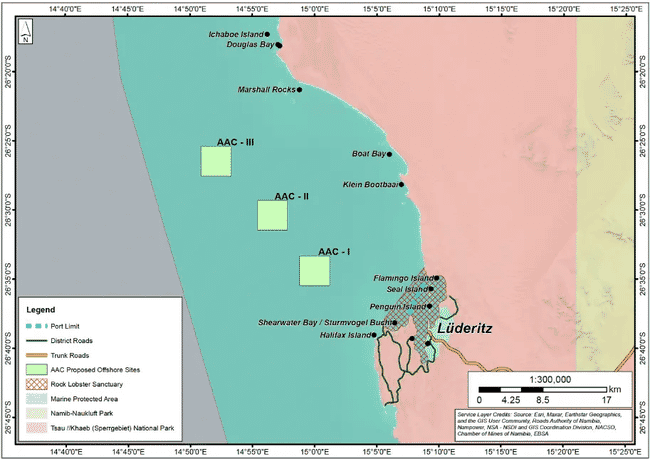
Led by Helge Krøgenes, the former CFO of Andfjord Salmon, African Aquaculture has been granted permits to establish offshore farms capable of producing 51,000 tonnes of salmon a year across three zones near the town of Lüderitz.
While the thought of farming salmon in West African waters might sound outlandish, Krøgenes notes that environmental conditions are very similar to those in Chile. The Namibia license locations have depths of roughly 90–120 metres and year-round water temperatures between 10°C and 16°C.
“These are really the sweet spot for salmon farming,” Krøgenes stresses.
Another key positive is that farming Atlantic salmon has been tried and tested in the region – in the mid-2010s, a small operation in Saldanha Bay, about 900 km down the coast in South Africa, produced them successfully for five to six years, before closing during the pandemic.
“They had very limited equipment but still the salmon was growing nicely in the Benguela Current,” Krøgenes says. “It’s basically the same water coming up to Lüderitz.”
While the previous farm used relatively basic infrastructure, Krøgenes says the new venture will deploy cutting-edge Norwegian equipment, including large-scale offshore net pens, predator-resistant HDPE nets to keep the region’s abundant Cape fur seals at bay, and automated feeding and net cleaning systems
“This is a Rolls Royce compared to what they were using,” he reflects.
As well as the biological advantage of the region, Krøgenes notes that Namibia’s political and economic profiles offer strong reasons for the project to both succeed and to attract investments.
“Namibia… is quite an attractive country in Africa to do investments in because of stable government, good financial systems,” he notes. “Our experience with the country so far is very good. We’re getting a lot of support.”
He also sees the benefits of working with the local fishing industry for both processing and transport of their salmon.
“The processors are very positive to take salmon locally from Namibia,” he says.
Meanwhile Krøgenes adds that their lower logistics costs will also provide a strong competitive edge in sub-Saharan markets. “Fresh salmon into South Africa has an air transport cost of €3.00 per kilo,” he says. “We think the transport cost to deliver to Cape Town is about €0.20. That’s going to be an advantage. There are also tax free zones in Africa which will benefit from Namibian production of salmon.”
And they are also looking towards the Middle Eastern and Asian markets.

Sourcing local smolt
While the farm’s equipment and feed will have to be imported from Europe, they will be able to source their smolt fairly locally – with plans to help develop an existing freshwater smolt operation in South Africa that has been producing ova and juveniles for more than two decades, for salmon farmers in Saldanha Bay and Lesotho’s trout sector.
The facility, which is located in Fizantakraal, is run by an African Aquaculture subsidiary called Arctic Salmon and currently has the capacity to produce around 1.5 to 3.0 million smolts each year – enough to translate to 5,000 – 10,000 tonnes of market-sized salmon – and will act as a stepping stone until the company has its own hatchery in Namibia.
Upgrades to the existing facility are already underway and Krøgenes would like to see the first batch of smolt stocked in the hatchery during the first quarter of 2026.
As the project expands African aquaculture plans to build its own hatchery, closer to their cages.
“We are going to build smolt facilities in Namibia, but this gives us a start,” Krøgenes explains.
Environmental planning
Environmental concerns need to be addressed before introducing salmon aquaculture into the region, but Krøgenes explains that the company has completed a comprehensive assessment.
“We have written a 360-page environmental report for the Ministry of Environment. And there are no suitable rivers with cold enough water in Namibia, so [salmon] will not be able to reproduce if you should get some escapes.”
Another major component of the project is the need for long-term local capacity building. The team is collaborating with universities in Namibia to develop national salmon farming expertise.
“Our aim is to educate Namibia to do salmon farming the same way which has happened in Chile,” Krøgenes says.
Training will combine Norwegian aquaculture modules, interactive learning platforms and hands-on systems at sea. “We are going to use expats in the beginning,” he says, “but the goal is local competence.”
A bullish financial outlook
The financial model drawn up by the company forecasts plan to raise €30 - 40 million in equity and debt for the initial phase. Thereafter the growth is assumed as a combination of reinvestment of cash-flow, debt and potentially listing of the company on the way forward to develop the 51,000-tonne capacity. And Krøgenes projects that the venture will start to turn a profit after only three years.
Given these figures, it’s perhaps not surprising that the venture is progressing toward financial close, with interest from both local and international investors, according to Krøgenes.
“We have some Namibian investors already… and Norwegian investors who are involved in the aquaculture industry as well as oil operations or licences in Namibia,” he says, adding that negotiations with several larger entities are also underway.
For Krøgenes, the appeal of Namibia can be summed up simply: it offers an unspoiled canvas for cutting-edge, efficient, salmon lice-free responsible salmon production.
“This is a greenfield opportunity for a much higher production volume,” he says. “We aim to do this as an environmentally friendly production… that’s high on the priority list.”
The tip of the iceberg?
Although African Aquaculture’s plans are the most advanced in the region, it is not the only offshore salmon farming initiative proposed for Namibia. Indeed, according to Krøgenes. another operator has been granted a licence for a 35,000-tonne site further offshore, while a major oil company has applied for a 10,000-tonne licence further south.
“We are the first out of the blocks, but we expect within 10 years [Namibia] might have a total production of about 150,000 tonnes,” Krøgenes predicts.
If this is the case, the clustering effect could create and support the same service-industry ecosystem that supports salmon farming in established regions today.
“When you build salmon farming, the service industry develops,” Krøgenes says. “It’s easier when several initiatives come… it supports the vessels, the smolt, all the other services.”
“Namibia is very far away from Norway… but it’s getting a huge level of support. It’s a big operation, but the conditions are right, the team is experienced, and the country is ready,” he concludes.


