
© Helge Skodvin
Birth rates across Europe are declining, and so is male fertility. Fertility problems affect around 17 percent of Norwegian men.
Could part of the solution lie in the past?
In earlier times, we consumed a much larger share of the fish than we do today. Nowadays we mostly eat fish fillet, but new research shows there are significant health benefits in eating parts such as skin, tendons and bones.
“Across several research projects, we have found positive health effects from protein powder made from salmon heads. The powder has proven beneficial for skin, hair and mental health,” said senior scientist Tone Aspevik at Nofima in a press release.
Now, the research team has reason to believe that salmon head proteins may also improve sperm quality, and thereby increase male fertility.
Protein powder production
Using advanced biotechnology, the researchers extract a protein powder with the right texture and flavour.
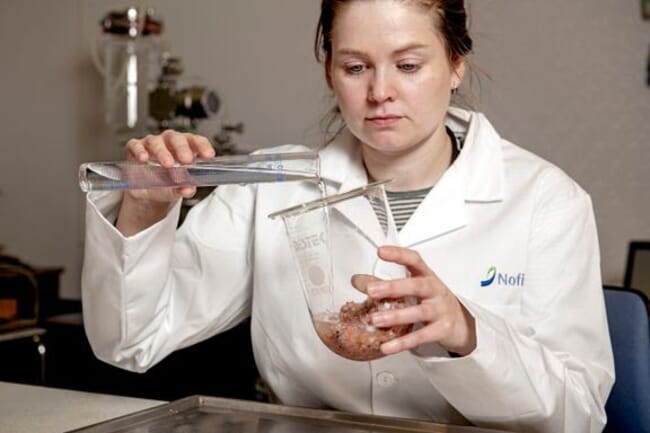
“At Nofima’s pilot plant, Biotep, we use state-of-the-art equipment to refine the salmon heads into an extremely pure protein powder,” Aspevik explained.
The resulting powder consists of more than 95 percent pure fish protein and minerals such as sodium, potassium, phosphorus and calcium.
Using every part of the fish
One reason Nofima’s scientists refine the salmon heads into protein powder is that it makes consumption easier. The material is broken down in a way that releases its bioactive properties. This approach also means that nothing goes to waste. The residual raw materials remaining after the protein powder is extracted are used for new products.
“We send fish bones to Italy to test their potential use as an ingredient in sunscreen. The extracted oil can be used in feed ingredients, while the process water is used to cultivate microalgae,” said Aspevik.
In this way, scientists have managed to utilise every part of the fish, creating added value and new high-quality products.
About the research
At Nofima in Bergen, the scientists tested a variety of processes based on salmon and cod. The bioactivity of the resulting products was first studied in cell culture before moving on to animal testing with project partners in Greece. Following a well-documented process, the team received authorisation to conduct trials on humans.
The protein powder has now been produced and will be sent to Lund University in Sweden, where volunteer participants will test the supplement.


