© B2E CoLAB
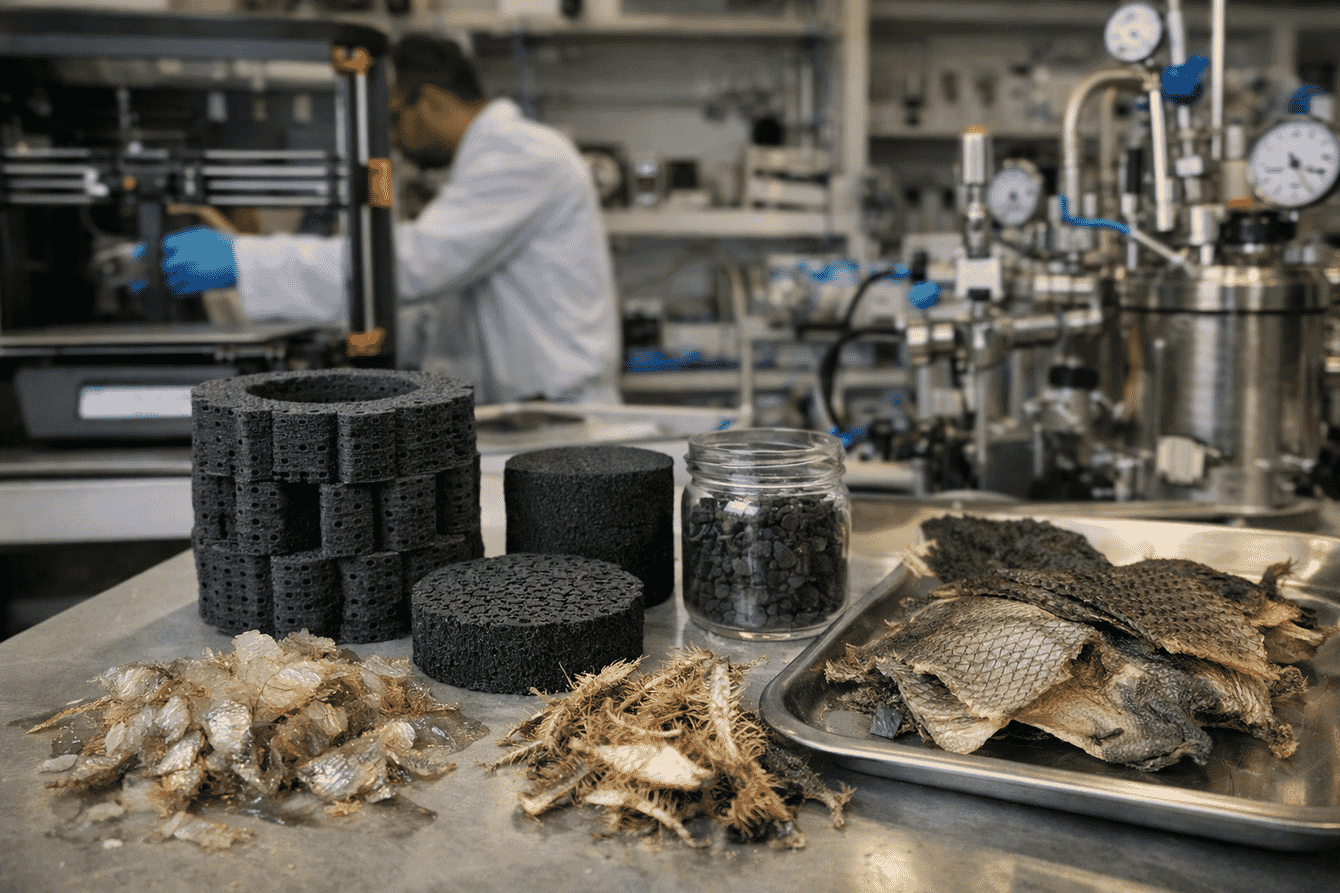
The project, known as AERO2cycle, will develop functional aerogels (ultra-light and highly porous materials) incorporating biochar, a carbon-rich material obtained through the controlled heating of organic waste in the absence of oxygen. In this case, the feedstock will include fish by-products such as scales, skin and bones.
This biochar will be combined with poly(ionic liquid) polymers, which exhibit a high affinity for CO2, resulting in hybrid materials capable of capturing and converting carbon dioxide. The materials will be structured through three-dimensional printing, enabling the design of reactors adaptable to different industrial configurations and facilitating their future integration into carbon capture systems.
Relevance in the European context
Within a European context shaped by carbon neutrality targets for 2050 and increasingly stringent regulatory requirements on industrial emissions, carbon capture and utilisation is gaining strategic importance, particularly for CO2-intensive sectors.
The technology under development can be integrated into industrial gas treatment systems, enabling the direct capture of carbon dioxide from emission streams generated by production processes. Potential applications include sectors such as energy production, cement, chemical industry, or waste-to-energy plants, where emissions are inherent to operations.
Beyond capture, the project will also explore the conversion of retained CO2 into industrially useful chemical compounds. These may serve as intermediates for specialty chemicals, ingredients for cosmetic formulations, sustainable polymeric materials, or components linked to energy storage technologies.
By transforming a gaseous waste into a resource with economic value, the project aims to contribute to the creation of new value chains based on captured carbon.
Towards real-world application
The technology has already been validated at laboratory scale. Throughout the project, the consortium will optimise material performance and test their functionality under conditions closer to operational environments, with the goal of future industrial integration.
The objective is to reduce the gap between scientific research and practical application, advancing technologically viable solutions that combine marine waste valorisation, advanced materials innovation and contribution to decarbonisation targets.
The project, funded by the Portuguese Foundation for Science and Technology (FCT), is led by NOVA.ID.FCT and includes the participation of the University of Évora and B2E CoLAB, with scientific collaboration from the University of Santiago de Compostela and Universitat Jaume I.