© Florida Atlantic University (FAU)
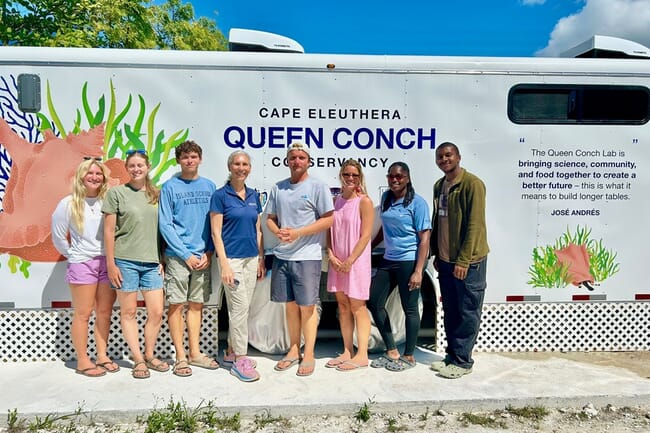
The initiative, a partnership between Florida Atlantic University’s Harbor Branch Oceanographic Institute and The Island School’s Cape Eleuthera Institute (CEI), aims to restore one of the Caribbean’s most culturally and ecologically significant marine species. Established in February, the mobile lab is designed to grow up to 2,000 juvenile queen conch annually for conservation and restoration efforts throughout the region.
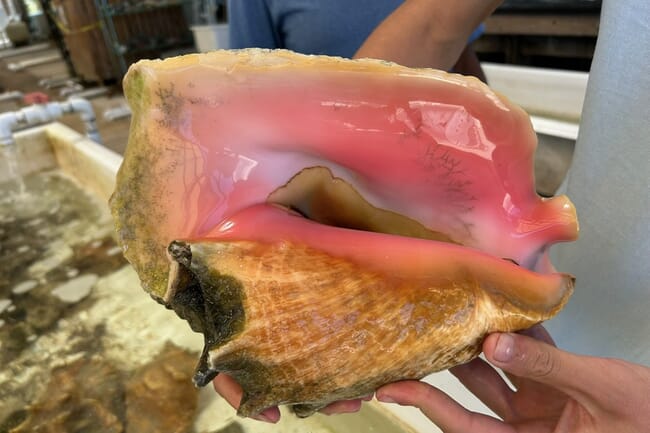
Researchers recently witnessed the first successful hatch in the mobile facility, producing approximately 200 newly metamorphosed conch. An additional 100 individuals from a second cohort have also completed metamorphosis, transitioning from free-swimming larvae to crawling juveniles. These juveniles will be raised for approximately one year before being released into local seagrass habitats.
“We are incredibly excited to reach these milestones because it represents far more than the successful launch of a mobile hatchery,” said Megan Davis, Ph.D., director of FAU Harbor Branch’s Queen Conch Lab and a research professor of aquaculture and stock enhancement. “Seeing the first egg masses and hatch in the mobile lab means we are now actively growing the next generation of queen conch for restoration, for healthy seagrass ecosystems and for the communities across The Bahamas.”
The self-contained, solar-powered hatchery measures approximately 26 feet by eight feet. It connects directly to local seawater sources, enabling advanced aquaculture in coastal communities without permanent infrastructure. The laboratory will also provide sustainable aquaculture education, workforce training, and outreach programmes for local residents, engaging between 1,000 and 1,500 visitors each year.
The project addresses a critical ecological need. Queen conch play a vital role in maintaining healthy seagrass beds by grazing on algae, but populations have declined severely due to overfishing. Between 1980 and 2020, approximately 31,000 tonnes of queen conch were harvested annually across the Caribbean. The species is currently listed as threatened under the Endangered Species Act, with surveys indicating Bahamian commercial fishing could become unsustainable within 10 to 15 years without intervention.
The Eleuthera facility is part of a broader regional vision by FAU Harbor Branch to establish community-based conch farms. Since 2022, the programme has expanded to multiple Caribbean locations, including Puerto Rico, Jamaica, and Curaçao. In 2025, Davis and assistant director Becky Holt received the Responsible Seafood Innovation Award from the Global Seafood Alliance for their community-driven restoration efforts.
The project is funded by chef José Andrés’ Longer Tables Fund, with initial planning support from The Moore Bahamas Foundation. Read the full story here.
© Florida Atlantic University