
© IFFO
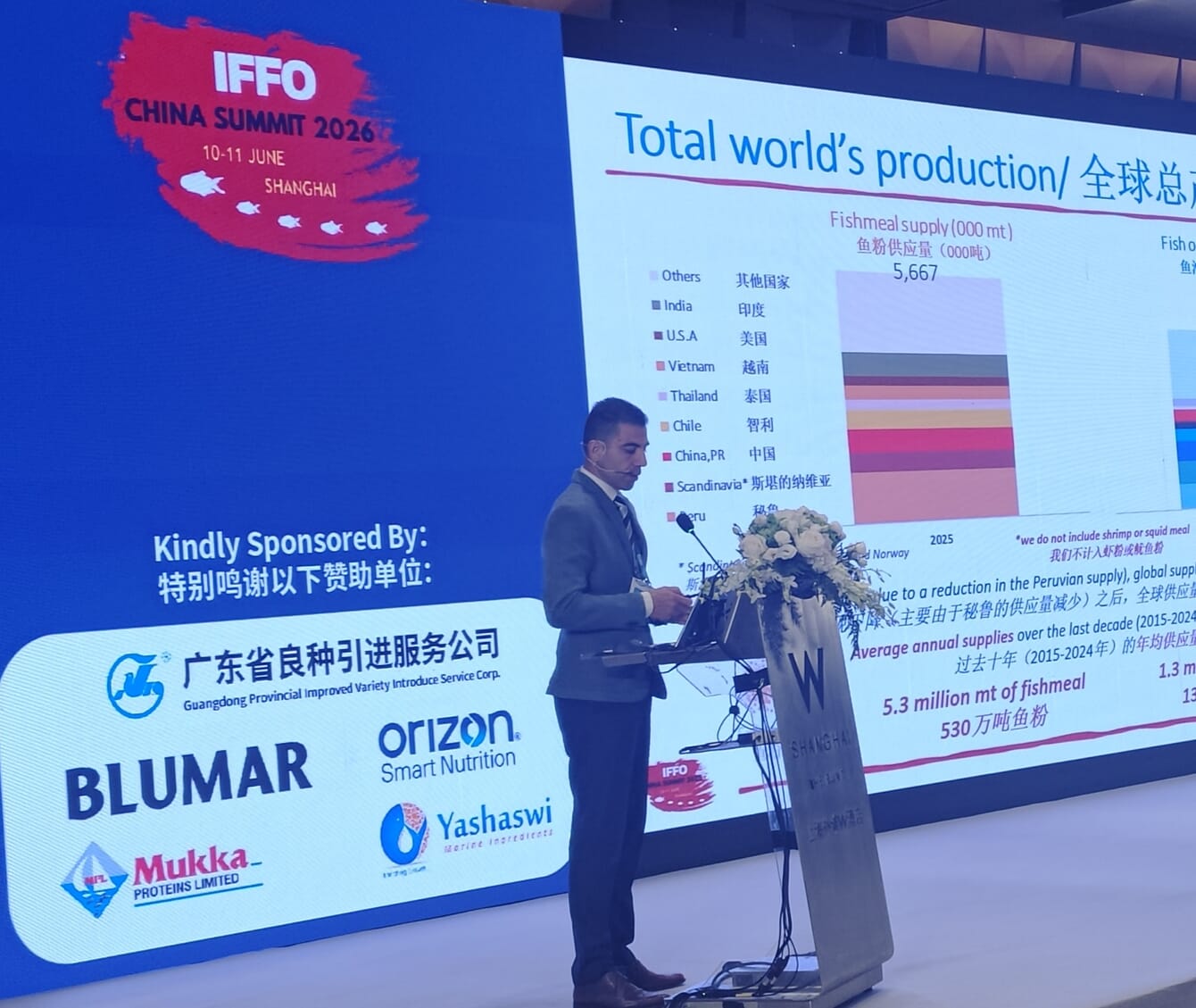
This year's IFFO China Summit, held in Shanghai from 10 to 11 June, once again broke records, with 221 attendees from 27 countries and regions. Discussions covered global supply and demand, market developments across key producing regions – Northern Europe, Chile, Peru, India, Vietnam and China – and certification systems.
Opening the event, Maggie Xu, IFFO's China director, said the organisation was delighted to welcome the industry back to China for another edition of what has become an annual event. China continues to play a central role in global aquaculture, both as the world's largest producer and as a leading user of marine ingredients. According to OECD-FAO estimates, China is expected to account for 42 percent of global fishmeal consumption by 2034.
China's production and consumption continue to soar
IFFO's market research director, Enrico Bachis, noted that global supply of fishmeal and fish oil has remained consistent with the average levels seen over the past decade. Asian countries account for roughly 35 percent of global fishmeal and fish oil production, while intra-regional trade continues to expand. Globally, almost 35 percent of fishmeal production came from by-products and around 57 percent of fish oil output; in Asia these figures rise to 44 and 74 percent respectively, with pangasius off-cuts playing a key role. Bachis noted that Asia has an annual supply gap of about 1.2 million mt for fishmeal and around 80,000 mt for fish oil, meaning the region will continue to rely on imports for the time being.
Impacts of El Niño in Peru
Jorge Risi, general manager at Peru's Sociedad Nacional de Pesquería, presented an update on the world's leading supplier, which accounts for roughly 8 percent of global catches and 22 percent of fishmeal and fish oil production. He explained that Peru's anchoveta fishery operates under a strict regulatory framework – seasonal quotas, continuous biomass assessments, individual vessel catch limits and precautionary measures to protect juvenile fish. This precautionary approach, in response to environmental instability from El Niño, has meant landings this year have fallen markedly. Risi stressed that future competitiveness relies on responsible, science-based management.
Salmon sector drives demand in Chile
Francisco Ovalle, Orizon's commercial manager, detailed Chile's long-term quota system, which ensures dominance in Jack Mackerel and its position as the world's second-largest salmon producer. While resource fundamentals are broadly healthy, some localised pressures remain in anchovy and sardine fisheries. Ovalle noted that China is the dominant customer, representing 49.1 percent of fishmeal exports, and that the salmon sector acts as the primary demand engine driving steady growth in feed production.
European certification demands moving markets
TripleNine's Kenneth Storbank reported that in Europe the salmon segment remains the main consumer, increasing demand and reducing exports as the region now depends on imports. Blue Whiting is by far the most important species for fishmeal, while trimmings dominate fish oil production. A declining spawning-stock biomass has led to a significant quota reduction this year, with coastal sharing agreements having failed since 2018. Storbank explained that European presence in Asia will grow from 2027 due to changing market fundamentals.
Growth continues in India
Arbee's John Joseph noted a steady recovery in marine landings – 3.57 million tons in 2025 and nearly 17 million tons of total fish production – with India now among the top three global producers and shipping to over 130 countries. He described the relationship with China as having matured into a solid, long-standing partnership. India's omega-3 supplements market is projected to grow at a CAGR of 10.9 percent, with pet nutrition the fastest-growing application segment.
Strong cooperation ensures growth in Vietnam
Kanematsu's Ngo Nha Truc highlighted increasing demand for high-quality aquafeed driven by shrimp, pangasius and marine fish farming. Domestic fishmeal production operates at only 60 to 70 percent due to raw material shortages, leaving Vietnam heavily dependent on imports for premium aquafeed. She argued that stronger cooperation between Vietnam and China will be important for long-term supply resilience.
Certification and the omega-3 market
MarinTrust's Nicola Clark outlined the global third-party certification programme covering responsible sourcing, production and traceability, emphasising by-product use and alignment with the FAO Code of Conduct. GOED's Aldo Bernasconi reported steady growth in the omega-3 market, with ingredient oil demand growing 3.4 percent in 2025 and pet nutrition expanding rapidly, especially in China.
Closing the regional picture, Zhaogang Jiang of Evergreen International Trade cautioned that China's fishmeal demand is real but not unlimited, with those limits becoming visible as feed mills use fishmeal more precisely.
Read the full press release on IFFO's website.


