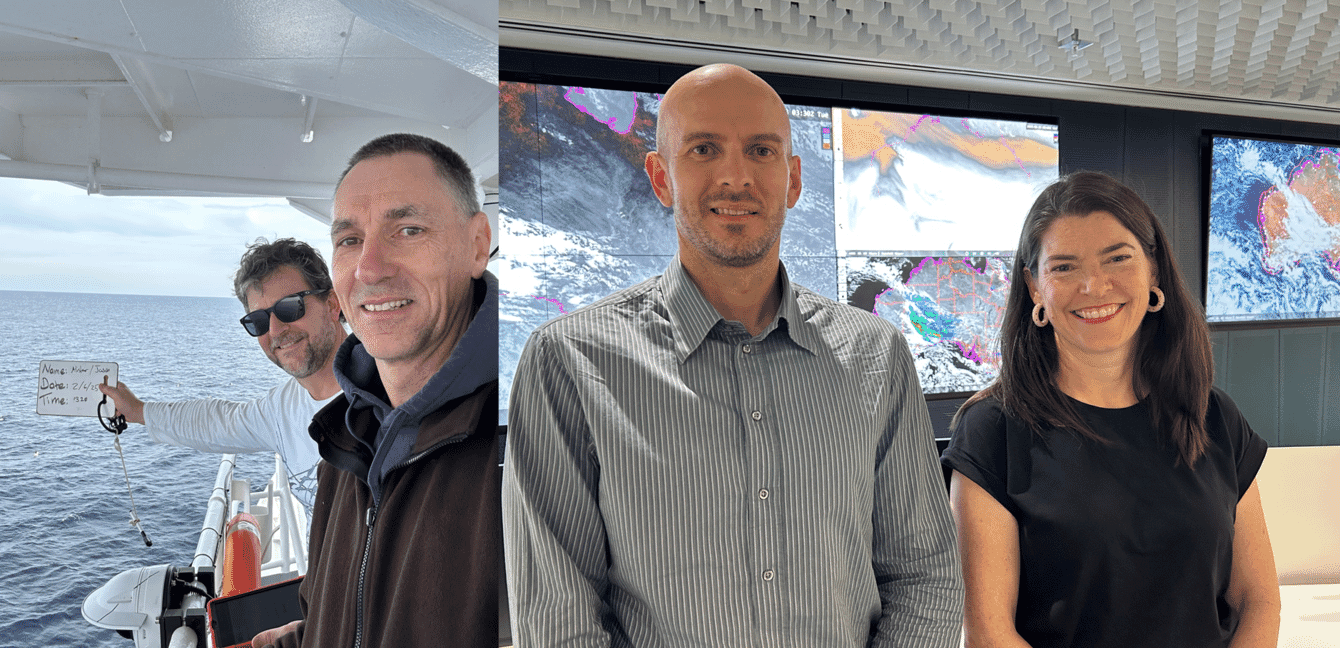
From left: Jason Hartog and Alistair Hobday (CSIRO), Grant Smith and Claire Spillman (BOM), have been selected as finalists for the Eureka Awards for their marine heatwaves forecasting © CSIRO
Developed by researchers from the Commonwealth Scientific and Industrial Research Organisation (CSIRO) and the Australian Bureau of Meteorology, the technology offers aquaculture producers, commercial fisheries and coastal managers vital time to mitigate heat stress, protect aquatic stock and respond to environmental risks.
Finalists in the 2026 NSW Department of Climate Change, Energy, the Environment and Water Eureka Prize for Environmental Research, the CSIRO-Bureau of Meteorology team has developed Australia’s first operational long-range forecasts for unusually warm ocean temperatures.
Marine heatwaves are a well-established cause of mass coral bleaching and severe biological disruptions, including fish kills, species migrating out of their usual range and extra pressure on endangered marine life. By forecasting the likelihood and location of extreme sea surface temperatures up to four months ahead, the system give marine industries, conservation managers and coastal communities weeks to months of warning, helping them prepare early and protect vulnerable species and ecosystems.
CSIRO’s Dr Alistair Hobday said once-rare marine heatwaves now occur with alarming regularity.
“However, marine heatwave forecasting provides the opportunity to develop rapid responses before events even occur,” Dr Hobday said in a press release.
The long-range marine heatwave outlooks are now a regular fixture over the Australian summer with forecasts made available publicly since the 2025-26 summer season. They are available on the Bureau of Meteorology website. Following the release of these forecasts, most States have now developed response plans, which set out the actions to be taken when an event is forecast.
“Over the past five years, this project has shown how a strong relationship between CSIRO and the Bureau of Meteorology (BOM) can result in world-leading scientific breakthroughs,” Dr Hobday added. “But it’s the connection we developed with the forecast users that has created the real-world impact and is also helping the long-range game – adapting to climate change.”