
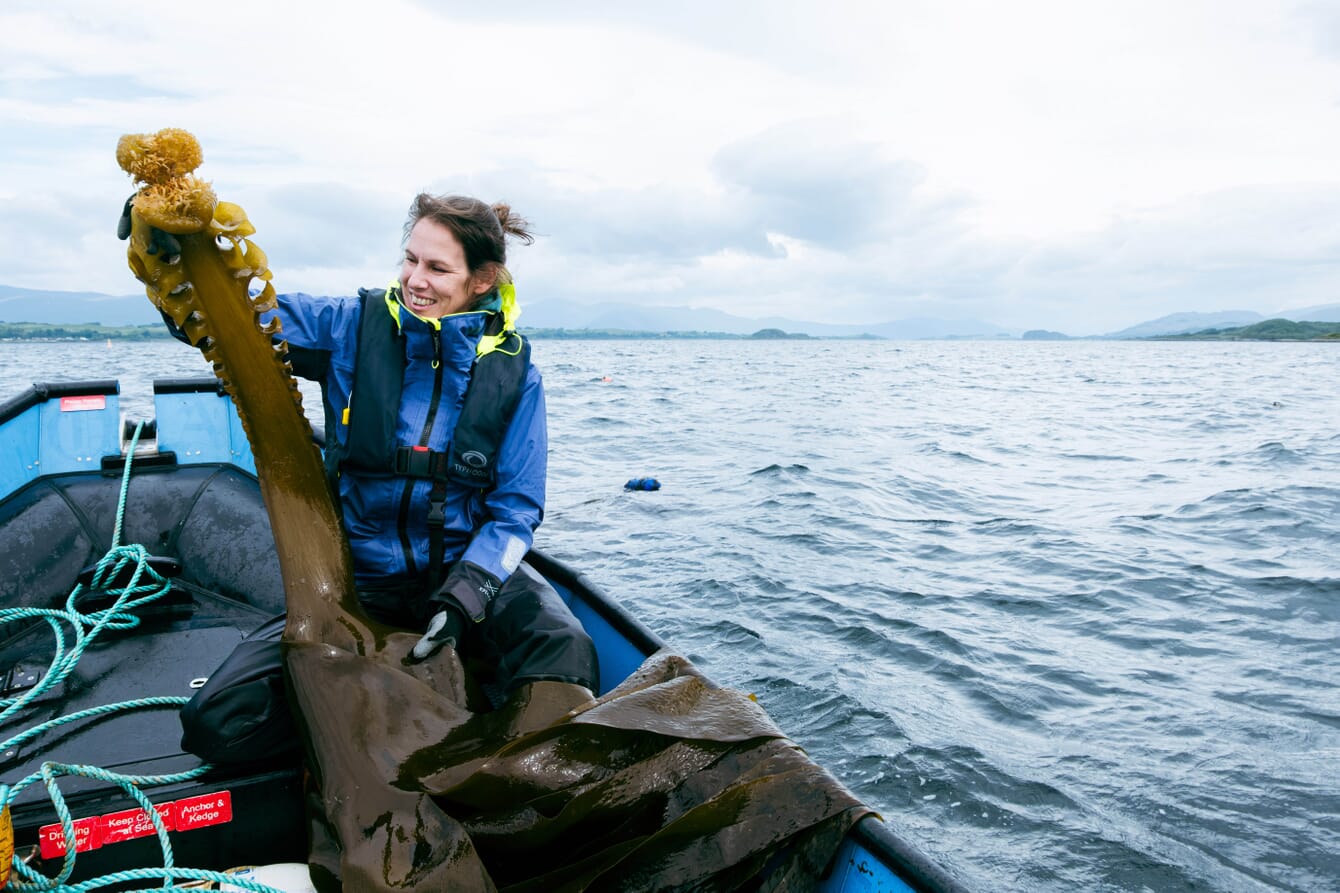
© SAMS
The report, ‘Seaweed farming with and for our coastal communities’ sets out six recommendations for policy makers and those planning to farm seaweed around the UK.
Among the recommendations is the need to prioritise local knowledge, work with communities and increase public awareness of seaweed farming. The report stresses the importance of gaining ‘social license’ for developments, a term used to describe activity that reduces potential conflict and promotes ethical approaches to operations, including community engagement.
Seaweed farming is projected to become a $27-billion-dollar global industry this year, with the overwhelming majority of activity in Asia. However, the European Union aims to scale production by 2030 to create 115,000 jobs in an industry worth €9 billion.
The new report’s lead author Dr Suzannah-Lynn Billing says the UK can capture part of this accelerating market by growing its seaweed sector, but warns that despite seaweed’s economic and environmental credentials, social licence for new developments is not guaranteed.
“When rooted in coastal communities’ needs and values, seaweed farming can create skilled local jobs and help to build social and economic resilience,” said Dr Billing in a press release. “However, opposition can emerge when proposed operations are misaligned with local values and livelihoods. There are already examples where ignoring coastal community voices within seaweed farm applications has led to conflict, such as the recent rejection of the Port Quin application in Cornwall.
“Trust in both farm operators and regulators depends on how open and transparent decision-making processes are. Where community engagement, trust and transparency are lacking, seaweed farms may struggle to obtain a social license.
The report has been published by SAMS, a partner of UHI, in collaboration with WWF-UK, Câr Y Môr, Centre for Environment Fisheries & Aquaculture, University College London, Seaweed Scotland.
Dr Piers Hart, aquaculture advisor at WWF-UK said: “WWF-UK sees growth in seaweed cultivation as an important part of our work in reducing the impacts of climate change, increasing marine biodiversity and supporting local coastal communities in the UK. Seaweed products can replace high carbon products such as plastics and fertilisers, whilst seaweed farms provide marine gardens supporting wildlife and absorbing excess nutrients.”
Dr Billing’s report is the result of a National Lottery funded project working with coastal communities in Pembrokeshire and seaweed farms across the UK: Unlocking the Power of Seaweed. This grant comes from the Climate Action Fund, a £100m commitment over 10 years from The National Lottery Community Fund to support communities across the UK to take action on climate change and involve more people in climate action.
As part of the project, the team created the film Coastal Voices, making space for the St David’s community in Pembrokeshire, to share their diverse perspectives on seaweed farming. The film shows that community support for seaweed farming is conditional on prioritising local needs and respecting and supporting the connection that the community has with their coastline and the place in which they live, work, play and recover.


