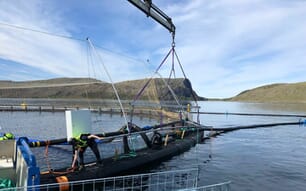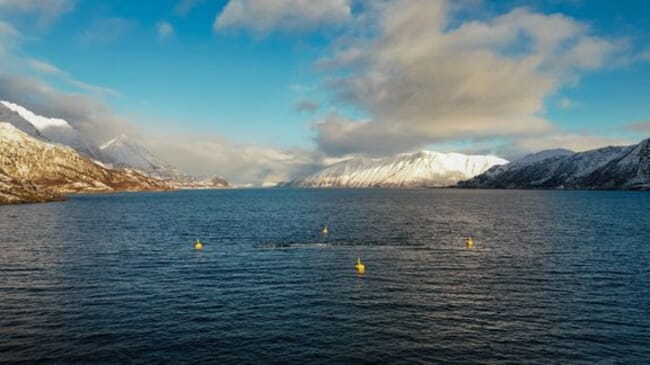
In 2024, salmon at several aquaculture sites along the coast of Northern Norway were harmed by string jellyfish, which injured and killed fish in the pens. The photo is from a site in Øksfjord, Finnmark in Northern Norway, where researchers are now testing brush walls as one of several measures against string jellyfish © Bendik Skogli, FHF
String jellyfish (Apolemia sp.) are long, rope-like colonial organisms that drift on ocean currents. In Norway, large blooms of string jellyfish have injured and killed millions of farmed fish over the past winters, leading to major losses for the aquaculture industry.
“We urgently need observations from fishers in Scotland, England and the Faroe Islands,” said Tina Oldham, project leader from Norway's Institute of Marine Research, in a press release. “Even the most effective protective measure is only helpful if we have early warning that jellyfish are coming.”
How UK, Irish, Faroese and North Atlantic fishers can help
Researchers believe string jellyfish pass west of Ireland, between the Faroe and Shetland islands, before reaching the Norwegian coast. They are asking fishers across the North Atlantic to report any sightings, and will used it to understand when, where and why string jellyfish occur.
Tone Falkenhaug from the Institute of Marine Research emphasised the importance of all observations, stating: “Even if you are not sure what you saw, please report it. Every sighting helps.”
A short English animation, with Faroese subtitles, has been made to help fishers recognise string jellyfish and sightings can be reported at dugnadforhavet.no.
Fishers in Scotland, England, Shetland, Orkney, the Faroes, Ireland and northern Britain are asked to assist the research by following four simple steps:
- Look for long, rope-like, jellyfish or jellyfish pieces.
- Take a photo, if possible.
- Report it at dugnadforhavet.no (an English version is available).
- Add position, date and a short note.
New protective measures
The need for early warning is part of the broader JellySafe project, which aims to develop practical solutions to reduce the harmful effects of Apolemia sp. on Norwegian aquaculture. Several strategies to protect salmon farms are being tested, including brush-wall barriers, electrical barriers, bubble curtains, and shielding skirts.
The JellySafe project is funded by the Norwegian Seafood Research Fund (FHF) with a budget of 35 million Norwegian kroner (approx. 3 million euros). Additional support is provided by the Institute of Marine Research and the University of Bergen, contributing 2.5 million Norwegian kroner (approx.. 213,000 euros).