
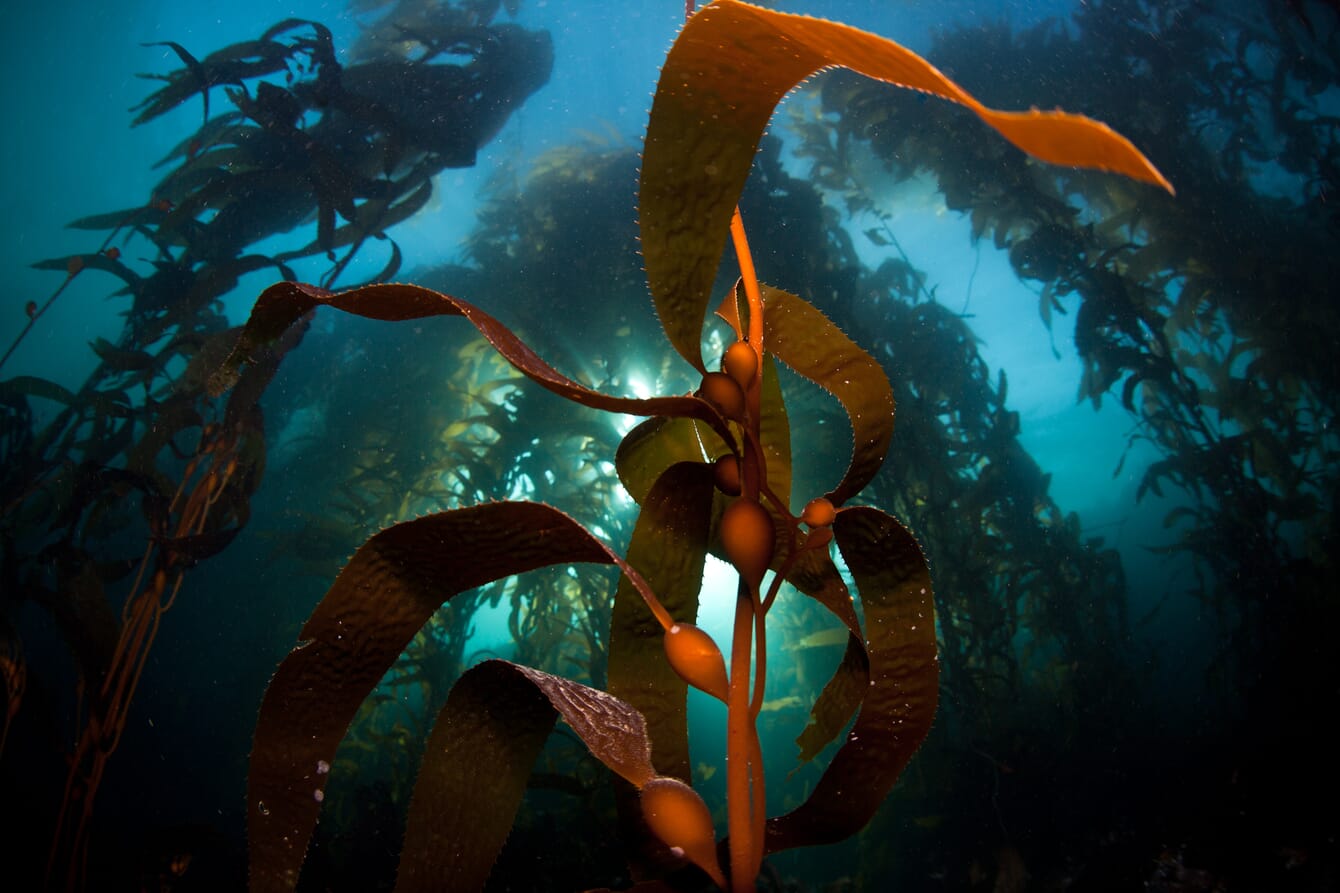
Seaweed can play an important role in global decarbonisation by replacing petroleum-based ingredients in a variety of products. Because marine algae grows rapidly without requiring intensive inputs – such as freshwater, land, or fertilisers – it avoids the heavy environmental footprint associated with conventional land-bound alternatives.
While seaweed aquaculture is already a major global industry, produced primarily for food and hydrocolloids, scaling seaweed-based products for decarbonisation such as biofuels and bio-stimulants will require significant expansion, along with improved technologies and processes to cultivate, harvest, and process biomass efficiently.
Ocean Visions’ new road map highlights the scientific, economic, technological, and policy conditions needed for seaweed-based products to contribute meaningfully to global decarbonisation. It focuses on five key sectoral opportunities:
- Agricultural Uses
- Biomaterials
- Critical Minerals
- Food Products and Animal Feed
- Biofuels
“Seaweed has real climate potential, but additional work and focus is needed,” said Ocean Visions senior program officer who led the development of the initiative, Nikhil Neelakantan, in a press release. “This road map is designed to help stakeholders identify where seaweed-based products can deliver meaningful decarbonisation and what it will take to scale them responsibly.”
Driving investment and policy support
The road map synthesises expert insights on scientific readiness, engineering and production challenges, financing and market barriers, environmental and social considerations, and policy and governance needs. An evolving resource, it will be updated regularly as advances occur in science, technology, markets, and policy.
Ocean Visions will work with partners to mobilise effort and investment toward priorities identified in the road map and to help address infrastructure and market challenges that currently limit scale-up.
“There’s not a lack of ideas, but rather a collection of constraints,” added Neelakantan.
Protecting ocean ecosystems
The initiative is part of Ocean Visions’ broader strategy to advance ocean-based pathways for decarbonisation. Accelerating these pathways will directly address the major harm inflicted on the ocean by rising greenhouse gas emissions, which drive ocean warming, acidification, and deoxygenation – crises that threaten marine ecosystems, economies and communities worldwide.
“Decarbonisation and ocean health are inseparable,” said Brad Ack, chief executive officer of Ocean Visions. “The ocean can play a critical role in reducing greenhouse gas emissions across energy, food, transportation, and agriculture sectors, but many of these pathways remain underdeveloped.”
To change this, the organisation works to accelerate the responsible development and scaling of potential ocean-climate solutions by identifying high-potential, underinvested opportunities, and convening experts across science, industry, and policy to mobilise action.
Development of the road map was guided by an advisory board that included Ling Cao (Xiamen University), Peter Green (Hatch Blue), Rod Fujita (formerly of Environmental Defense Fund), and Simon Freeman (Wetstone, formerly ARPA-E Mariner program). The process included a deep assessment of all available information about potential product pathways, and the evidence base was further shaped during a May to June 2026 public comment period.
“Seaweed is full of climate promise,” Ack concluded. “This road map provides the foundation for a shared understanding of opportunities, constraints, and priority actions to accelerate the sustainable production of seaweed-based products.”

