
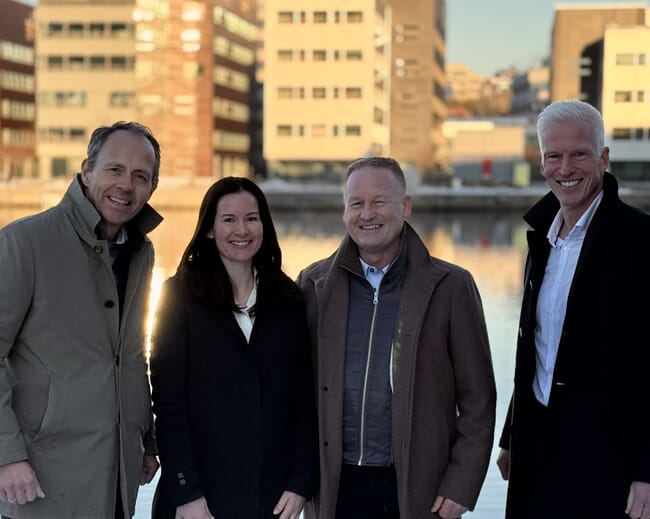
From left: Jan Roger Bjerkestrand (CEO, GC Rieber AS), Ann Kristin Feidje (investment manager, GC Rieber AS), Geir Olav Meling (CEO, Biomega Group AS) and Espen Aanderud (CFO and investment director, GC Rieber AS) © GC Rieber AS
GC Rieber AS has entered into an agreement to acquire 100 percent of the shares in Biomega Group AS. The acquisition includes all the companies in the Biomega Group, including Biomega Norway AS and Biomega Denmark A/S. Biomega will continue as an independent portfolio company within GC Rieber Group. The objective is to secure continued operations, safeguard jobs and to further develop Biomega’s role in the value chain for utilisation of marine raw materials from salmon and trout.
“Biomega has a highly competent workforce and a unique technology utilising marine by-products producing high-value ingredients, contributing to the circular value chain in the aquaculture industry. At the same time, the company is in a challenging financial situation. We are entering as owners because we believe there is significant value creation potential in the company, and because we believe we can make a difference being a long-term owner contributing with growth capital and industrial expertise,” said Espen Aanderud, incoming chair of the board of Biomega and CFO & investment director in GC Rieber AS.
Biomega is a well-established company turning marine by-products into marine proteins and marine oils for use in animal feed and human nutrition. With more than 25 years of experience, the company has developed a strong professional environment holding a leading position in an important circular value chain for the aquaculture industry. Biomega has offices in Bergen, Norway and production facilities outside Bergen and in Hirtshals, Denmark.
“In Biomega, we turn marine by-products into high value products, being a valuable partner for the industry. We have built a business that has served as a problem-solver for the industry and, over time, become a central part of value creation in a circular value chain,” added Geir Olav Melingen, chief executive of Biomega Group AS, in a press release.
“We have been through a similar journey with GC Rieber VivoMega in Kristiansund. Over time, we have invested, scaled, and built a robust business within highly concentrated omega-3 ingredients from fish oil and micro algae, serving international customers. GC Rieber has worked with fish oils for more than one hundred years, with industrial production dating back to 1920. We are now bringing that experience with us into the work with Biomega,” said Jan Roger Bjerkestrand, chief executive of GC Rieber AS.
Long-term ownership to secure jobs and unlock value
GC Rieber will provide the necessary capital and work closely with Biomega’s employees and suppliers to stabilise operations and build a robust foundation for continued value creation. The acquisition takes place during a challenging time for Biomega, where the main challenges have been financial and structural, rather than related to professional capacity or delivery capability. GC Rieber is entering in a demanding situation and will focus on securing continued operations, safeguard jobs and strengthening the collaboration with key suppliers and partners.
Biomega was acquired in 2017 by the American investor AMERRA Capital Management. Through this new acquisition, the company will once again have Norwegian ownership, with local anchoring and a long- term industrial perspective.
“For us, it means a great deal to have a strong Norwegian owner like GC Rieber, with a long-term industrial perspective. It is truly great to be part of the journey of bringing the company back under Norwegian ownership. It provides security for employees, customers, suppliers and partners,” added Melingen.
Completion of the transaction is subject to the fulfilment of certain customary closing conditions, which the parties expect to be satisfied within a short timeframe.


