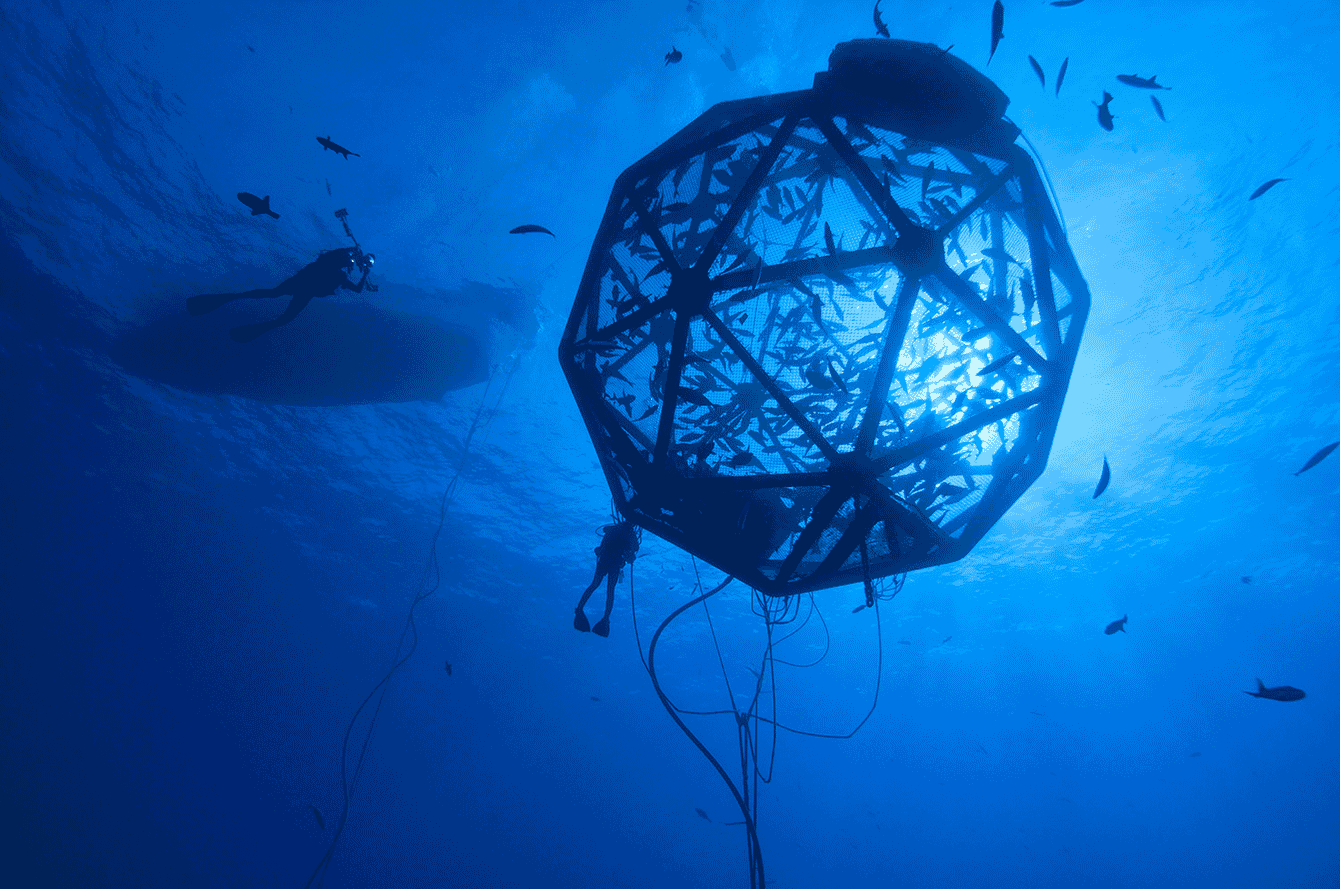
Ocean Era’s prior Velella Beta-test demonstration project pioneered the permit process for aquaculture in Federal waters, offshore of Kona, Hawai`i © Rick Decker
This milestone allows the project – dubbed “Velella Epsilon” – to proceed.
“Barring the unforeseen, the project – supported by the National SeaGrant Program, and in partnership with University of Miami – should now be able to move forward by early 2027,” said Ocean Era’s founder and chief executive, Neil Anthony Sims, in a press release. Sims noted that the demonstration aims to show local fishing and boating communities the benefits of offshore aquaculture.
“A further goal was to pioneer the permitting process for offshore aquaculture in Federal waters in the Gulf,” Sims added. “So, as a demonstration project, it has been tremendously successful, in that it has demonstrated with abundant clarity that regulatory reform is sorely needed.”
The Velella Epsilon project faced a protracted eight-year permitting process that involved navigating through nine different Federal and State laws, and engaging with twelve different federal and state agencies, as well as responding to anti-aquaculture activist appeals that were consistently rejected as baseless by the EPA’s Environmental Appeals Board.
“This proposed project is a very small-scale, temporary demonstration – just a single, small batch of fish. The project will be closely monitored for environmental and social impacts, and the results will all be made publicly available,” said Sims.
Sims expressed hope that the US Congress could resolve these regulatory hurdles through the Marine Aquaculture Research for America Act (the MARA Act). This bipartisan bill would authorise the National Oceanic and Atmospheric Administration (NOAA) to permit additional offshore demonstration projects.
GulfStream Aquaculture LLC, a Florida-based environmental consulting company, led the project’s permitting process, as a largely pro-bono effort. Dennis Peters, the firm’s principal, provided over $450,000 worth of environmental and technical expertise and advice to the project over the eight years.
Building on experience in Hawaii
Sims was one of the original founders of what is now the Blue Ocean Mariculture farm, offshore of Kona, Hawai`i. This farm has been producing up to 900 tonnes of sashimi-grade Hawaiian Kanpachi annually for over 20 years. Extensive environmental monitoring has shown no significant impact on water quality, or on the seabed beneath the net pens, or the pristine stretch of coral reef located a mere half mile inshore of the farm site.
Earlier iterations of the Velella Projects were located in Federal waters offshore of Kona. These proved to be spectacular fishing hot-spots, with the net pen acting as a Fish Aggregating Device (FAD), attracting wahoo, mahimahi, tuna, and marlin. The plan for the Velella Epsilon is to now bring this experience to the Gulf fishing community.
“We want Florida folks to see for themselves, rather than have their decisions made for them by activist groups who blithely ignore the evidence in the water. That’s the whole point of a small-scale demonstration project,” said Sims.
Prominent global environmental organisations – including the Environmental Defence Fund, the World Wildlife Fund, Conservation International, and The Nature Conservancy – now advocate for expanding sustainable aquaculture to meet global seafood demand. The Environmental Defence Fund is actively leading advocacy for the MARA Act through the Coalition for Sustainable Aquaculture.
“The environmental arguments all now underscore the need for increasing aquaculture production – it is one of the least impactful forms of animal protein production,” Sims concluded, emphasising the need for domestic food security.