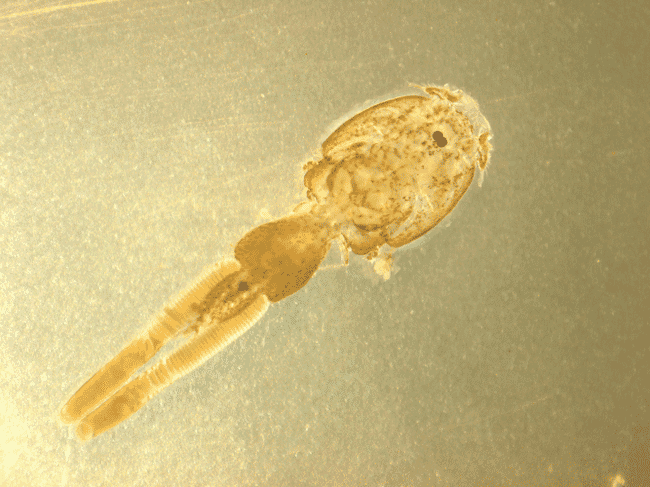
Like other parasites, such as mosquitoes and ticks, salmon lice secrete substances from their glands which make it easier for them to feed or evade their host’s immune system. The research, published in the journal Veterinary Parasitology, compared secretory proteins released by infectious larval-stage salmon lice (copepodids) with those found in adult lice.
Led by PhD researcher Alexander Dindial alongside colleagues Professor James Bron and Dr Sean Monaghan at the Institute of Aquaculture, in collaboration with Kevin McLean of the Moredun Research Institute, the team found 143 secretory proteins in copepodid secretions that are absent in adults.
Salmon lice feed on the skin, mucus, and blood of the host, causing open wounds that can lead to infection – reducing their market value, and increasing the chances of secondary infections and susceptibility to other diseases.
“Because this is the very first stage of this parasite’s life cycle, it represents a vital linchpin in control strategies for this species,” explained lead researcher Alexander Dindial in a press release. “This work better helps us understand salmon louse biology and could play a vital role in informing future research into control of this parasite, such as through the identification of vaccine targets, which ultimately promote the sustainable production of healthy salmon and enhance global food security.”
Methodology
The study involved incubating larval salmon lice in filtered seawater and isophorone – a chemical found in salmon mucus that attracts copepodids. Researchers then used liquid chromatography tandem mass spectrometry to analyse the protein compositions. This state-of-the-art technique separates sample components and breaks them into fragments to reveal their molecular make-up.
Researchers then filtered the data, identifying the proteins, determining which were secretory in origin, and comparing the compositions of each of the samples. Among the findings were serpins – proteins previously identified in terrestrial ectoparasites – which play a role in limiting the host’s immune response.
Dr Sean Monaghan, co-supervisor of the study, added: “This data provides key candidates for vaccines in the future. We are currently exploring the genes of these secreted proteins as part of a large BBSRC funded project, GeNoLice to determine if they are influenced by interactions with the host.”
The study was led by the University of Stirling, working in collaboration with the Moredun Research Institute and funded by EastBio.