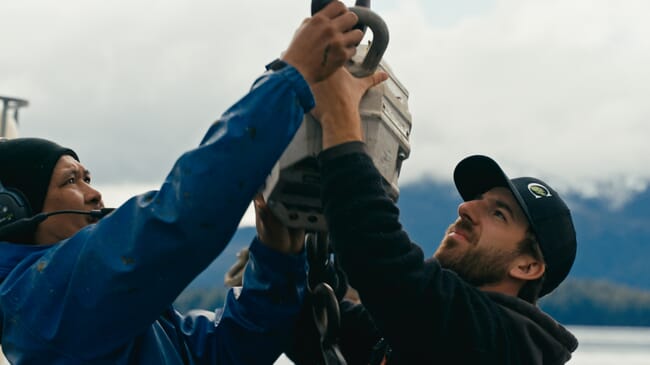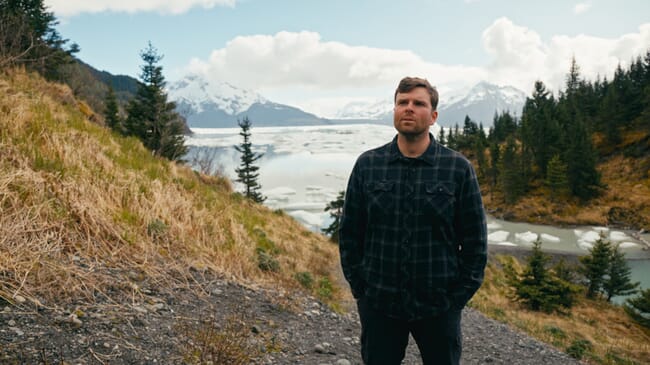
“We’re just two people with a boat and a vision,” says Den, who juggles his role as a commercial seaweed farmer with his work as mariculture liaison for the Chugach Regional Resources Commission.
“We want to do more than study the ocean – we want to actively heal it. And kelp farming is one of the most hopeful tools we’ve found,” he adds.
Den ventured into mariculture after a decade working as a fisheries biologist.
“I spent years studying salmon, but I wanted to be more directly involved in helping their habitat,” he explains. “Kelp farming felt like a natural next step – it’s regenerative, restorative and aligns with the rhythms of the ocean and community.”
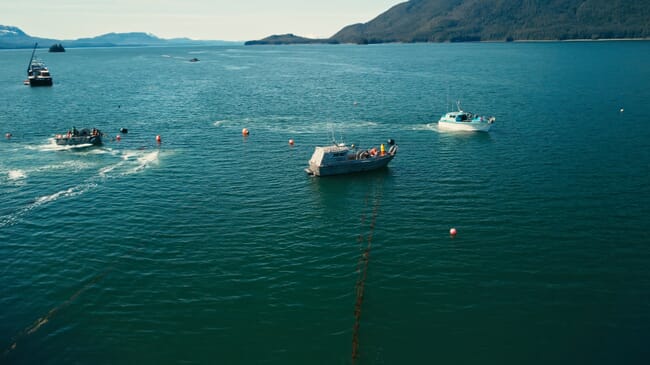
After several years of trial and error they underwent a permit amendment to relocate their farm to a more suitable area. During the relocation they also upgraded their farming system to a TendOcean catenary array – a system that is showing great promise.
“This year, our harvest exceeded expectations,” Den reflects. “It’s the first time we’ve felt like we really have something scalable.”
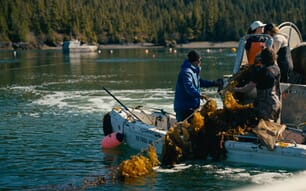
While Alaska’s pioneering seaweed producers are all still small, there have been encouraging examples of collaboration: Noble Ocean recently teamed up with fellow farmers Royal Ocean Kelp Co and Wild Blue Mariculture to fulfil a large order for Cascadia Seaweed, one of Canada’s leading kelp producers and processors.
“No single farm had enough volume,” Den Adel explains, “but by working together, we aggregated a harvest that was meaningful enough for Cascadia to come to us.”
Meanwhile Cascadia has partnered with Mothers of Millions, which has a mobile kelp processing unit, to handle the on-site processing directly on the water, allowing producers like Noble Ocean to focus on farming, while Cascadia has streamlined the route to market.
According to Cam Kinsman, a mechanical engineer at Cascadia Seaweed, their partnership with Noble Ocean and other Cordova farms signals “a major step forward in proving that small-scale, community-based seaweed farming can meet commercial demands.”
“The quality was high, and the teamwork from Cordova’s farmers was impressive,” he adds.
For Den, selling kelp to Cascadia for use as agricultural fertiliser was particularly meaningful.
“We’re supporting the regenerative food movement,” he says. “Kelp enriches soil, helps with drought resilience, and it's grown without fertiliser or fresh water. It’s full-circle sustainability.”
Despite these promising developments, Den is realistic about the challenges that remain. “Right now, we’re at the edge of a breakthrough, but we need infrastructure to catch up,” he says.
High on his wishlist is a shared community processing facility.
“That would be a game-changer. Right now, without a permanent processing hub, we rely on pop-up solutions and mobile teams. Those are great stopgaps, but not long-term,” he reflects.
Efforts are underway. Organisations such as the Native Conservancy and Prince William Sound Economic Development District are working to secure funding and space for processing operations.
“We have the momentum,” Den says. “We just need to lock it in while it’s still building.”
To further reduce costs and risks for new farmers, efforts are also being made to launch a local kelp nursery.
“Right now, we have to ship in kelp seed from outside the region,” Den explains. “Having a seed nursery in Cordova would not only cut down on transportation costs, but it would allow us to plant during optimal weather windows, which is critical.”
Cordova is quickly becoming one of Alaska’s most promising mariculture hubs, thanks in part to its engaged community and strategic location. Den’s work as a mariculture liaison has helped align local governments, tribal organisations, nonprofits and entrepreneurs around making mariculture a viable part of the local economy.
“There are highly knowledgeable mariners in Cordova,” he says. “People who already have the vessels, the skills and the desire to stay connected to the ocean. Kelp farming gives them another way to live and work on the water.”
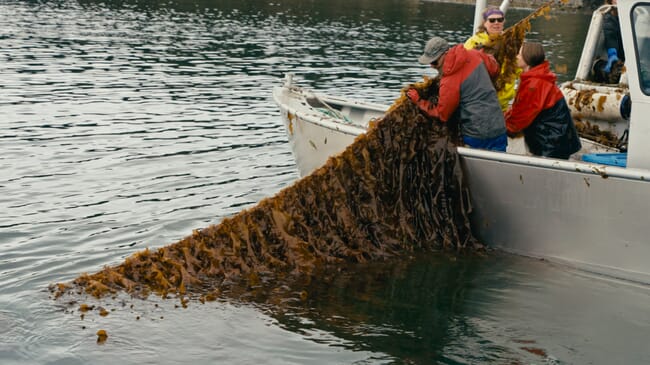
Meanwhile, each growing season brings new lessons.
“This year, we realised the importance of having a vessel large enough to stabilise the kelp as it comes out of the water,” Den reflects. “When you’re limited by what fits on a small boat, harvesting takes forever. Tapping into the local fleet – boats that aren’t being used in the shoulder season – is the future.”
Noble Ocean also plans to upgrade its farm design.
“We’re looking at expanding our five-line arrays and modifying the catenary system to improve depth control. The better we get at holding kelp in its sweet spot in the water column, the more biomass we’ll grow per foot,” he explains.
For Den, kelp farming is far more than just a day job for the few.
“I want to see kelp farming here providing food security, economic resilience and a regenerative economy,” he says. “We’re not just growing kelp, we’re growing possibilities – for farmers, for fish and for the future.”
*This article is part of a project commissioned by the SEC to highlight the region's mariculture sector. To learn more about the sector visit https://alaska.seaweedinsights...