

© Karlotta Rieve
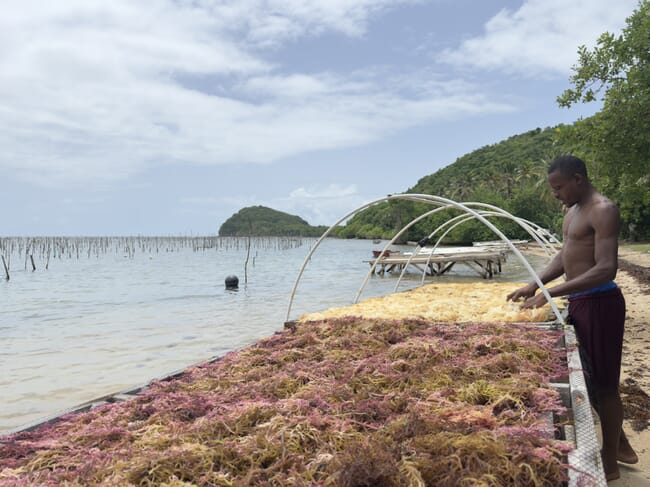
The key seaweed species being farmed in the region is Kappaphycus alvarezii, which is known locally as "seamoss". Depending on the variety, morphology and post-harvest treatment used it is sold when either purple, green or golden. Green and purple seamoss typically fetch higher prices, but have to be handled more carefully to maintain their pigmentation – usually hang-dried, but not directly under the sun. Meanwhile, to achieve the golden colour it is bleached under a transparent cover in the sun.
Locally the dried seamoss is popularly used in "seamoss drink", a thick, sweet beverage that blends milk (often condensed or plant-based), spices and seamoss, which is traditionally consumed as an energy booster and natural aphrodisiac. When exported it mainly goes into the health supplement market in North America and Europe.
The economics are compelling, particularly further down the value chain. In St Lucia, which boasts the region's longest seaweed production history, dating back to the 1980s, dry seamoss fetches between US $12-$30 per kg at the farm gate, but can jump to $100 per kg at wholesale. In Grenada, the average farm gate price hovers around $30 per dry kg. However, St Vincent and the Grenadines (SVG) sees both the highest farm gate price, at $30-40 per dry kg, and the largest value-chain increase. Here, seamoss can reach a staggering $360 per kg at retail – a nine-fold increase from its raw, dried price.
Simple farming systems
Most farms in the Eastern Caribbean are small-scale, family-run operations. St Lucia has 130 registered farmers, though many more operate informally. In SVG, 175 farmers are spread across Bequia, Canouan, Mayreau and Union Island, while there are about 80 farmers currently active on Grenada.
They rely on simple and accessible methods – primarily off-bottom, hanging long-line, or floating raft systems. (More details on these systems are soon to be published on the Seaweed Insights website.) Farm size varies. In St Lucia, farms may have between 50 and 200 lines, each 10–15 metres long. In the Grenadines and Grenada, many farms are closer to only 20–30 lines each.
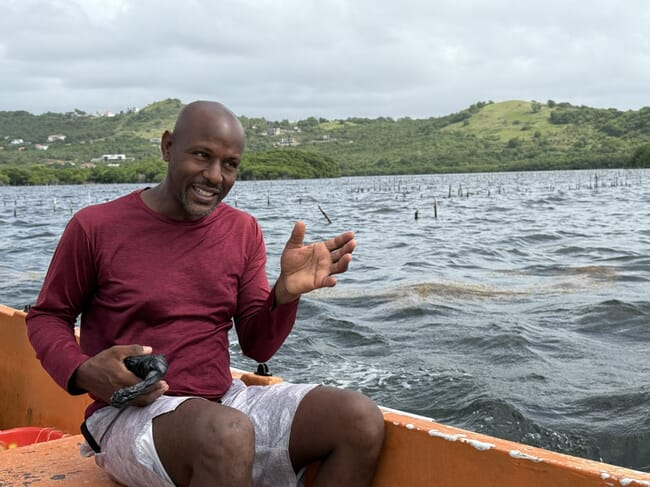
While this simplicity keeps farmers’ overheads low, it makes them vulnerable to weather damage. It also creates labour challenges, as the work is intensive, but the pay struggles to compete with other sectors. Several farmers who I met noted that younger people prefer jobs in tourism, where wages are typically higher and the work is less physically demanding. This makes it difficult to attract new entrants, even as seamoss provides a steady supplementary income for established farming families.
Beyond labour, farmers face a daunting list of operational hurdles. Drying their crops is one of the most consistent and pressing challenges across the region. Sun drying is the primary method, with seaweed spread on racks, mats, or even bare ground. The process is slow, labour-intensive, and entirely weather-dependent.
Transport and logistics add another layer of complexity. Moving dried seaweed from small islands to buyers overseas is costly and time-consuming. Export shipments need to meet food safety as well as sanitary and phytosanitary (SPS) regulations, which require samples to be sent for analysis by the authorities.
© Karlotta Rieve
Environmental pros and cons
The marine environment of the Eastern Caribbean is generally well-suited to tropical seaweed farming. Coastal waters across the three groups of islands remain warm year-round, typically within the optimal 27–30 °C range. Farmers report little seasonal temperature fluctuation, a significant advantage over regions further from the equator. Light penetration is another strength of the Caribbean waters, which are typically clear, allowing photosynthesis even when lines are set at depths of 1–2 metres.
However, the environment also presents challenges. Nutrient availability is complex; in open coastal waters, nutrients can be limited, constraining growth rates. Farms located closer to river mouths may benefit from nutrient input, but this comes with significant risks. Excess runoff during the rainy season increases turbidity, encourages epiphytes and can stress the seaweed.
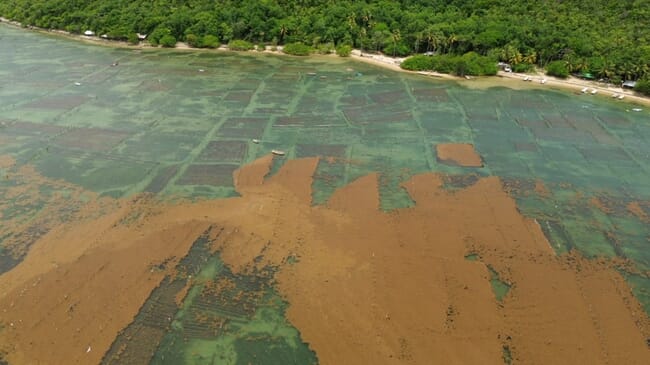
Moreover, the increasingly heavy influxes of sargassum seaweed continue to seriously impact farms. Blooms originate from the Great Atlantic Sargassum Belt, fuelled by warming waters, shifting currents, and nutrient runoff from major rivers. The North Equatorial Current and related surface currents transport this sargassum westward from the tropical Atlantic, causing floating mats to first strike the windward (Atlantic-facing) shores of the islands. The sargassum smothers the farmed seaweed, blocking sunlight, stopping growth and causing the crop to disintegrate. When the sargassum carpet is thick, it also makes navigating boats to and from the farms impossible, as well as generating health risks for the farmers when it decomposes – as it releases hydrogen sulphide and ammonia that can cause respiratory irritation, headaches and nausea.
© Karlotta Rieve
The Caribbean is no stranger to storms, and farmers across the region are highly exposed to the risk of hurricanes and strong swells destroying their farms. In 2024 Hurricane Beryl provided a devastating example, leaving major damage in its wake and setting many farming efforts back in the most affected islands of SVG – Canouan, Mayreau and Union Island – as well as Carricou in Grenada. This underscored the extreme vulnerability of these small island developing states.
“Losses from recent severe weather events have been extremely damaging to our farms,” explains Brian Walker, vice-president of the Eau Piquant Farmers Association of St Lucia.
“This is one of the reasons that we are aggressively pushing to develop a proposal for an insurance coverage for us,” he adds.
The storm has also left farmers like Walker pulling double duty.
“I have been very busy also, balancing between trying to replant my farm and participating in stakeholder consultations,” he reflects.
© Karlotta Rieve
Building resilience through organisation and innovation
Despite its fragility, the sector is full of determination and local ingenuity, with seamoss associations emerging as key entities to organise farmers.
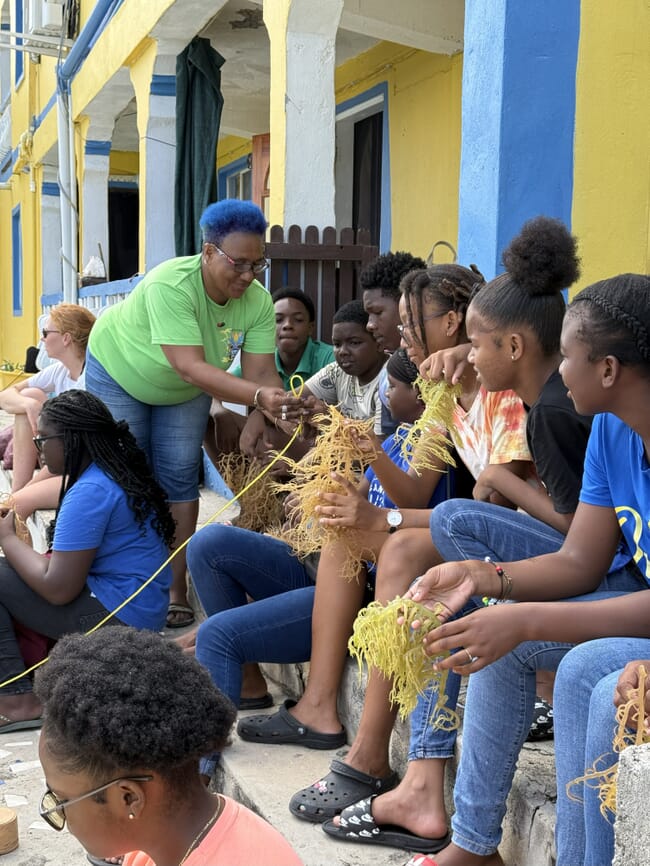
The St Vincent and the Grenadines Seamoss Association, for instance, has developed a week-long internship programme for students. This takes the participants through every step of the process – from farming and harvesting to developing their own value-added products.
Innovating and diversifying with product development is crucial, as the market itself is shifting. While the seamoss export market remains promising, it is far from the boom seen during the Covid pandemic, which was driven by a surge in demand for immune-boosting natural products and online wellness trends, and later slowed as consumer attention shifted and supply chains normalised.
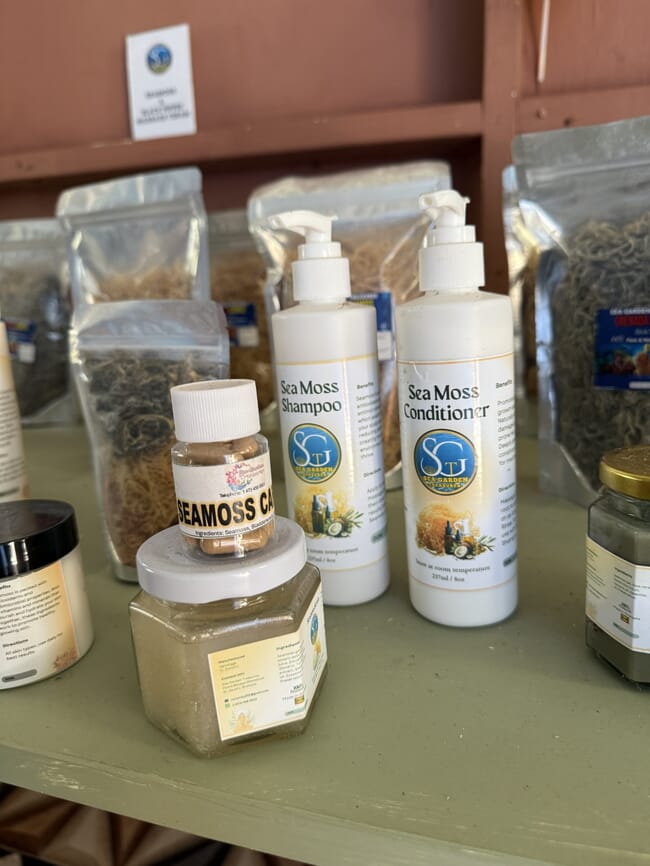
On a domestic level, however, creativity is flourishing. A wide range of consumer products can be found and enjoyed across the region, including seamoss health drinks, wine, soaps and other cosmetic products. These demonstrate an impressive local drive to capture the full value of the crop, transforming a simple seaweed into a cornerstone of a burgeoning blue economy.
*Hatch Blue will launch the extension of their Seaweed Insights website, at the end of January 2026, where detailed farm level insights from these Caribbean islands will be published.
© Karlotta Rieve


