
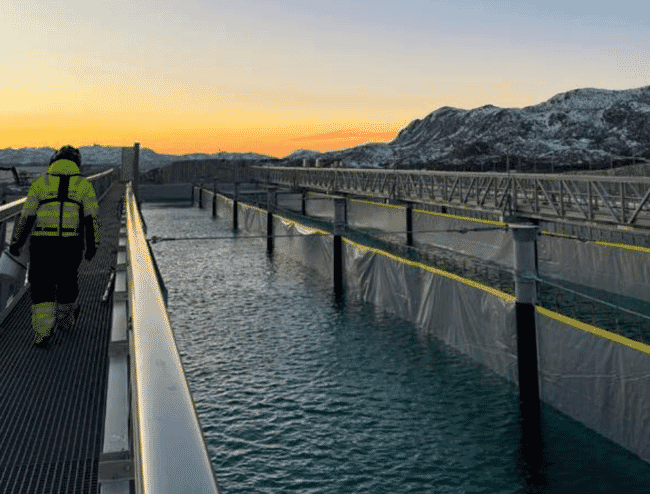
© Gigante Salmon
The decision follows a successful pilot conducted during periods of high oxygen demand. The company began integrating the nanobubble systems in 2025 and will scale up with additional units over the coming year, in line with production growth.
“Freya solved the oxygenation challenges we previously faced. It was a whole new world for us when we experienced the significant improvement in oxygen dissolution using nanobubbles. We have to say this was a necessity for our operating model, and Moleaer’s technology is definitely a contributor to achieving our production targets,” said Tore Laugsand, deputy CEO of Gigante Salmon, in a press release. “The flexibility allows us to scale in line with our production needs.”
Gigante Salmon will begin harvesting a new generation toward the end of the fourth quarter of 2025. The company expects the entire production facility to be fully operational by the second quarter of 2026. Further expansion of the facility is in its final phase, with two of three production basins completed and on track for a planned ramp-up to full capacity of 16,000 tonnes annually by 2028.
Moleaer’s nanobubble technology is designed for sea cages, holding tanks, hatcheries, recirculating aquaculture systems, and emergency use. Nanobubbles remain neutrally buoyant and support key biological and physical processes in water, helping producers improve oxygen efficiency, enhance fish performance, and manage oxygen costs more effectively.
“Producers don’t typically have an oxygen supply problem but with oxygen dissolution,” said Inge Haarberg of Moleaer. “Freya addresses this by delivering oxygen where fish need it, with market-leading gas transfer efficiency to improve water quality while reducing oxygen and energy costs. This gives producers a more robust and cost-effective way to maintain stable DO [dissolved oxygen] levels as biomass increases.”


