*The previous version of this article has been replaced by a report from the project managers involved, who are awaiting approval from the Yellow Sea Fisheries Research Institute before the original can be restored.
China as one of the global leaders in shrimp aquaculture produces upwards of 2 million tonnes per year. The leading mariculture shrimp species in China is the pacific white shrimp (Penaeus vannamei). These require water temperature within the range of 26 – 33 ºC for the most efficient growth, with their optimal reported at 27 ºC (Wyban et al., 1995; Rahman et al., 2007). This species is mostly cultured in the earthen and lined ponds which is the most widely practised open air culture method in many provinces, accounting for approximately 70 percent of the total production. However, owing to several limitations on regulating diseases, maintaining biosecurity, production costs, and the inability of continuing the culture cycle in the cold winter durations, the shrimp farming shifted towards a more industrial-based greenhouse farm system model and has rapidly expanded over recent years.
These greenhouse farms are constructed with plastic film covering small-scale concrete tanks where shrimp are cultured in an enclosed space. This enables temperature control in the system, with additional water heaters in the tanks for maintaining the water temperature at desirable levels. This system improves the efficiency of heat retention, especially during the colder periods, thus facilitating a higher production efficiency, even during winter.
Despite its popularity, this model also has its drawbacks. The energy consumption of these greenhouse systems is remarkably high during the winter periods, leading to higher operational costs. In addition, during peak summer. when the outdoor temperatures can reach close to 40 ºC, the interior temperatures of these greenhouse systems can reach beyond 60 ºC, leading to increased water temperature and inconsistent thermal fluctuations within the systems, creating unfavourable working conditions.
Air domes and their applications in aquaculture
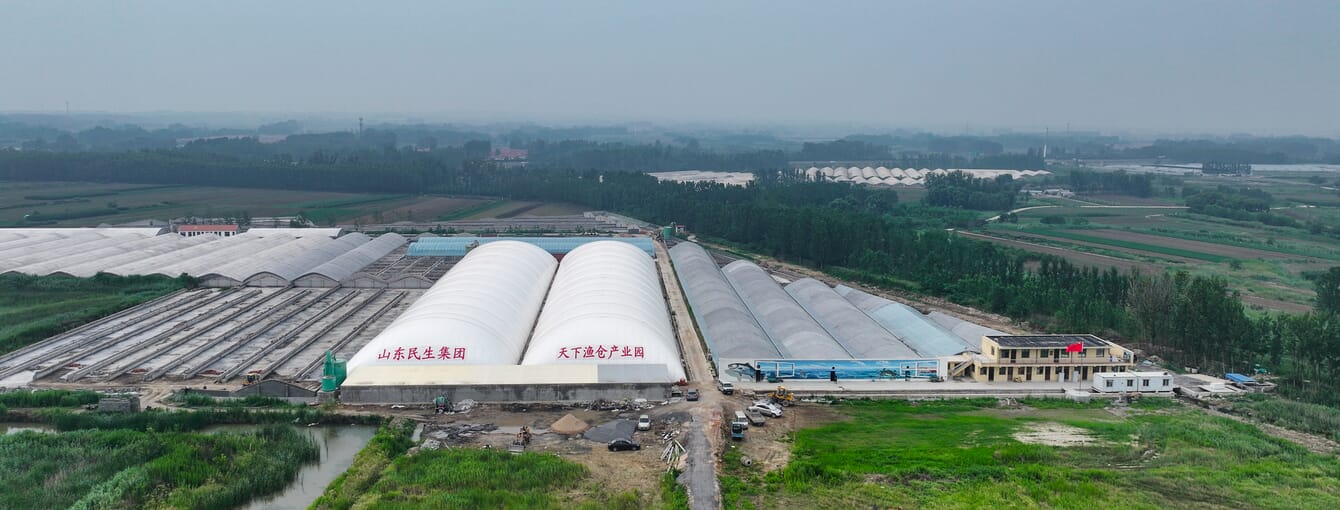
As the most recent advancement of adopting a controlled-environment system to improve biosecurity, water quality, and production efficiency, some shrimp farms in China are experimenting with inflatable air domes. These are large, lightweight enclosures held up by internal air pressure rather than rigid framing. They are made of durable fabric membranes with an enclosed curved surface. These domes act as both the roof and the wall and are anchored over the intensive shrimp tanks, creating a fully enclosed biosecure perimeter in the farms.
The dome’s shape is maintained and held upright by air blowers that keeps the air inside slightly pressurised by about 100-200 Pa higher than the outside. Air locks placed at the entrances keep the pressure difference constant. The dome is comprised of double layer membranes with thermal insulation sheets inserted between them to improve the insulation performance. In addition, translucent sheets are placed at the top of the dome to keep the sunlight diffusion at appropriate levels. The membrane is mostly made of materials like polyester fibre coated with PVC and PVDF films. These air domes have recently gained popularity owing to its versatility of applications in different fields such as in sports to shield indoor tennis courts, soccer fields, swimming pools, and in various research fields as controlled test spaces. However, the application of this structure in aquaculture practices has been relatively recent, with only a few pilot projects and commercial trials demonstrating its potential benefits in shrimp farming.
Benefits for shrimp aquaculture
This novel approach in aquaculture is more environmentally friendly and more effective than the conventional greenhouse systems and has a better control over the daily climate control. It can reduce the temperature fluctuations within the system, facilitating a constant temperature control inside the dome while protecting the ponds from rain, wind or extreme sunlight. The consistent stable environmental conditions support better feed conversion, reduce stress, thus resulting in improved survival and growth rates. These structures better facilitate the production of bioflocs and can perform with recirculating aquaculture systems, thus reducing the water exchange. The enclosed air dome systems can limit the entry of pathogens, and wildlife access, providing better biosecurity. Air-supported domes require less structural steel or insulation compared to conventional greenhouses and has an easy scalability as they can be installed over existing pond infrastructures.
Pilot-scale applications of air domes and related research studies
This innovative aquaculture model was trialled by the Minsheng Aquaculture Group in Shandong Province, China, where P. vannamei were being reared inside an inflatable air dome as part of a pilot project. In addition to shrimp cultivation, the facility also explores broader applications of this enclosed system within aquaculture. In total, there are two experimental aquaculture trials in progress to determine the effectiveness of this air inflated dome over the greenhouse system for shrimp aquaculture production. Both trials were conducted concurrently, utilising the same systems, shrimp and setup.
One of the experiments focused on determination of the growth performance of P. vannamei held in two different environment-controlled setups: the air dome and the traditional greenhouse system, respectively. In the six-week experiment, juvenile shrimp with an average initial weight 1.88 g and 3 mm body length were stocked at a density of 400 shrimps/m3 in two separate air dome system and greenhouse system, each within replications in three concrete tanks (6.5 m × 6.5 m × 1.6m). The shrimp in both systems were fed with the same commercial grow out feed according to their body weight five times a day. The feed was fortified with vitamin premix, garlic bioactive extracts and Chinese herbal supplements to maintain the intestinal health. A 3% water exchange in each tank is carried out before each feeding the shrimp to remove any debris and faecal matter. Routine checks on dissolved oxygen (>6 mg/l), salinity (21 ‰) and nitrite (<0.5 mg/l) levels were performed to ensure optimal water quality in each tank and feed intake is assessed using feed trays one hour after each feeding routine to make sure the feed consumption is at acceptable levels. Water for the culture tanks in both setups are sourced from underground wells which pump water to a holding tank, upon which the water is transferred to a sedimentation tank to remove any debris and then heated to approximately 30 °C before being distributed to the culture tanks.
The second experiment, also conducted over an six-week period, investigated the growth performance and hepatopancreatic function of shrimp reared at different stocking densities within the controlled environment of this air inflated dome system. In this experiment, P. vannamei (average initial size: weight 1.88 g and length 3 mm), were stocked at four different stocking densities namely 400/m3, 500/m3 600/m3 and 700/m3 in concrete tanks of size 6.5 m × 6.5 m × 1.6m, and each treatment is conducted in three replicate tanks. The shrimp were maintained using the same methods as the first experiment for feeding and cleaning. At the end of the trial duration, the shrimp were measured for weight, growth performance and hepatopancreatic samples will be collected to assess the enzymatic function of each treatment group.
The result from trial 1 showed that there was a measurable difference between the temperature profile of the air and the water. The temperature was more stable providing better growing conditions under the air dome. The daily temperature fluctuation was upwards of 24 ℃ in the greenhouse system between the highest and the lowest temperature while only 2.9 ℃ fluctuation was typically observed in the air dome system. Although the average daily water temperature was about 1 ℃ higher in greenhouse system, compared to the air dome system, it still had a noticeable 1.1 ℃ daily fluctuation which was not of benefit to the shrimp. The daily water temperature fluctuation was negligible at 0.2 ℃ in the air dome system. Moreover, the other benefit was clearly on the staff and people who enter the air dome compared to the traditional greenhouse. The shrimp grew well in the air dome system with 13.41 percent faster than those in the greenhouse system based on the growth data, which would return good value. The second experiment is ongoing, and we hope to report the results soon, and determine the optimal stocking density in the air dome system.
The results of these two experiments are expected to widen the understanding of how the novel technological approach of using an inflatable thermally insulated air dome can contribute to the improvement of aquaculture practices.
Environmental and economic considerations
While initial costs are higher than greenhouse systems, long-term operational efficiency, higher yields, and reduced disease risks can offset the initial cost of investment. Energy use for blowers is modest compared to heating or cooling entire facilities. Materials are often recyclable, aligning with sustainability goals. The long-term benefits really need to be assessed and compared to traditional greenhouse and also earthen pond systems. Each growing site and system will have certain pros and cons associated with it. We need to balance the need for efficient, bio secure food production systems with the risks associated with open air systems, that are largely uncontrolled environments. Once proven, the technology could be transferred to other aquaculture species allowing more flexibility in growing areas. The other main advantage of the air dome technology is that it provides a more stable and comfortable working environment for the staff. This means that staff can spend more time in the growing area, managing the system and ensuring the wellbeing of the shrimp.
Future directions
Pilot scale projects are underway to test the feasibility of using these inflatable air domes for rearing other species and as holding facilities for other aquatic species.