
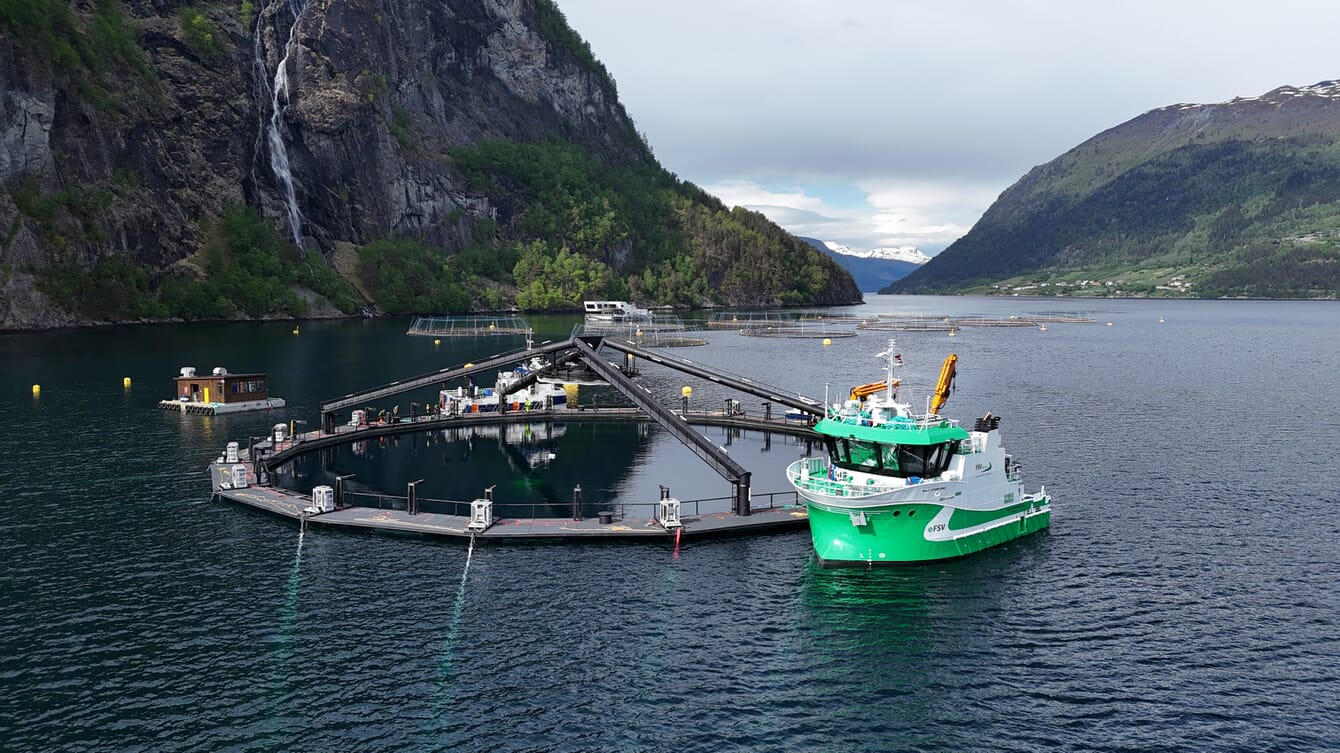
© Trident Aqua Services
Trident Aqua Services has entered into an agreement with Hofseth for the delivery and operation of two new, modern hybrid vessels for Hofseth’s aquaculture operations. The vessels, Multi Storfjord and Multi Navigator, are now fully operational, marking an important milestone in both companies' shared ambition to develop more sustainable, efficient and biosecure solutions for the aquaculture industry. Following their initial deployment, the two vessels will be officially named at a public ceremony taking place on 13 June 2026 in Ålesund, Norway.
The vessels were developed by Trident Aqua Services, designed by Solstrand Trading and built at Sletta Verft. Both units are tailored to work in close interaction with Hofseth’s land-based infrastructure, enabling more efficient and future-oriented operations. Designed as multi-purpose units, the vessels are equipped to handle a wide range of activities, from mooring work to advanced service operations. Multi Storfjord is fitted with a 1500 kWh battery pack, while Multi Navigator has a 1125 kWh battery pack, allowing both vessels to operate solely on battery power for a full 12-hour working day. Combined with Hofseth’s innovative investment in shore power, the vessels will contribute to significant reductions in fuel consumption, CO₂ emissions and noise.
These vessels have been developed to ensure a high degree of biosecurity and stable operations under demanding conditions. With integrated systems for ROV operations, net cleaning and electrically driven pump solutions, work can be carried out within controlled parameters with reduced risk of cross-contamination. This provides increased control and more efficient use of resources, while supporting strict requirements for fish welfare and disease prevention.
The hybrid solutions provide significant benefits, with an estimated daily energy consumption of 2,420 kWh drawn from shore power across both vessels. On an annual basis, this replaces approximately 200,000 liters of fuel, assuming daily charging and normal operations. Through connection to Hofseth’s shore power facilities, the vessels can operate with minimal use of fossil fuel, contributing to lower emissions, reduced energy consumption, less noise and an improved working environment on board.
“As the world’s largest provider of vessel services to the aquaculture industry, we have a responsibility to drive development forward. These vessels show how we combine technology, experience and innovation to deliver solutions that create real value for our customers,” said Arild Aasmyr, chief executive of Trident Aqua Services, in a press release.
“We are always looking for new solutions and technology that provide more efficient operations, lower emissions and a safer everyday working environment for both people and fish. These vessels fit well with how we want to develop the future of aquaculture in Storfjorden” added Roger Hofseth, chief executive of Hofseth. He points out that the collaboration with Trident Aqua Services provides access to future-oriented technology and operational expertise that help strengthen efficiency, biosecurity and fish welfare in day-to-day operations.

