
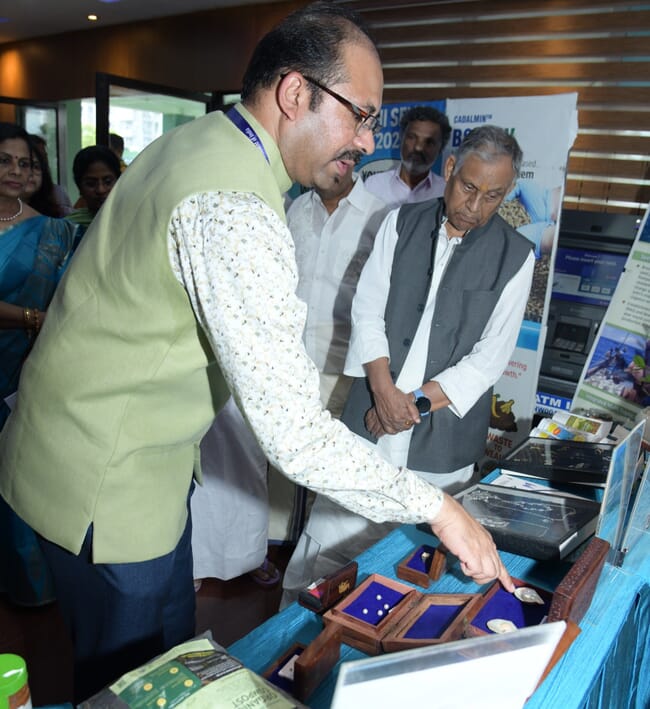
Union minister Ram Nath Thakur examining mabe pearls developed by ICAR-CMFRI from oysters during his visit to the institute © CMFRI
A detailed scientific study is required to assess the potential of year-round integrated paddy-fish farming in Kerala’s Pokkali fields, according to Shri Ram Nath Thakur, the union minister of state for agriculture and farmers’ welfare in the Government of India. The minister emphasised the need to enhance farmer income while ensuring ecological and socio-economic sustainability, stating that the full potential of Pokkali fields must be tapped in a sustainable manner.
Shri Ram Nath Thakur was responding to requests from farmers seeking permission to conduct fish farming in the area throughout the year, rather than adhering to existing seasonal regulations. Speaking during a visit to the Pokkali fields on January 5, the union minister clarified that a comprehensive evaluation of prevailing laws, environmental implications – and long-term socio-economic impacts – must precede any such regulatory change.
Currently, rice cultivation is permitted in Pokkali fields from June to October, during the low-salinity period, while fish farming is allowed from November to April, when salinity levels are high.
The minister maintained that understanding the feasibility and consequences of extending fish farming beyond the present season is essential before arriving at a policy decision.
“Science-based assessments are crucial to strike a balance between productivity, the livelihoods of farmers and traditional fishermen, and ecosystem conservation,” he said in a press release.
Research outputs geared towards rural livelihoods
The visit was coordinated by the Ernakulam Krishi Vigyan Kendra (KVK) of the ICAR-Central Marine Fisheries Research Institute (CMFRI). The CMFRI director, Dr Grinson George, stated that if the state government permits, Ernakulam KVK is ready to undertake a comprehensive scientific and socio-economic study into the prospects of year-round integrated paddy-fish farming.
Dr George proposed a pilot experimental farm covering 50 acres of Pokkali fields to generate evidence-based data for future policy interventions. Later, during his visit to the CMFRI headquaters, Shri Ram Nath Thakur urged scientific community to ensure that research outcomes translate into tangible benefits for farmers in rural areas.
The minister also released CMFRI’s new product named Cadalmin BSF Green Organic Compost, which utilises a zero-waste bioconversion technology derived from black soldier fly larvae. Additionally, a publication on Technology for Designer Pearl Production, and products of ICAR-Central Institute of Fisheries Technology were also released during the function.


